

How to organize an authentic Alentejo wine tasting
TL;DR:
- An Alentejo wine tasting reflects the region's authenticity and terroir.
- Organisation involves careful selection of grape varieties, a controlled environment, and rigorous sensory methodology.
- Valuing traditional products such as "vinho de talha" (amphora wine) enriches the cultural experience.
Organising an Alentejo wine tasting is much more than just lining up bottles on a table. It's a ritual that evokes the soul of a region where the scorching sun shapes unique grape varieties and the terroir whispers stories in every glass. Alentejo accounts for over 40% of the value of certified wine sales in Portugal, attracting over 200,000 wine tourism visitors every year. There's a reason for this: the regional identity is unmistakable. This guide was created to help you recreate this experience authentically, whether at home or at a private event, step by step.
Index
- Preparation: essential requirements for an Alentejo wine tasting
- Step-by-step: structure and order for tasting Alentejo wines
- Sensory methodology: visual, olfactory, and gustatory evaluation techniques
- Authenticity and regional nuances: how to value Alentejo's terroir
- What truly distinguishes an authentic Alentejo wine tasting
- Explore more: experiences, itineraries, and tips for wine lovers
- Frequently asked questions
Key Takeaways
| Point | Details |
|---|---|
| Careful wine selection | Choosing between 3 and 6 wines from autochthonous Alentejo grape varieties determines the authenticity of the tasting. |
| Environment preparation | A neutral environment, without competing aromas, and appropriate materials are essential to maximise the experience. |
| Rigorous sensory structure | Evaluating each wine through visual, olfactory, and gustatory stages using ISO glasses and neutral bread enhances the analysis. |
| Valuing terroir | Including nuances of soil, grape varieties, and local techniques such as amphora wines reinforces the regional character. |
Preparation: essential requirements for an Alentejo wine tasting
Now that you understand the importance of authenticity, it's crucial to know that preparing a tasting requires attention to both the wine and the environment. Every detail counts, from the choice of grape varieties to the glass you place on the table.
Start by selecting the wines. To ensure regional representation, select 4 to 6 wines from autochthonous grape varieties such as Antão Vaz, Arinto, and Roupeiro for whites, and Alicante Bouschet, Trincadeira, Aragonez, and Castelão for reds. These Alentejo grape varieties are the most honest expression of the territory. When choosing producers, prioritise sustainability and regional grape varieties certified by Alentejo's WASP program, which ensures responsible vineyard practices.
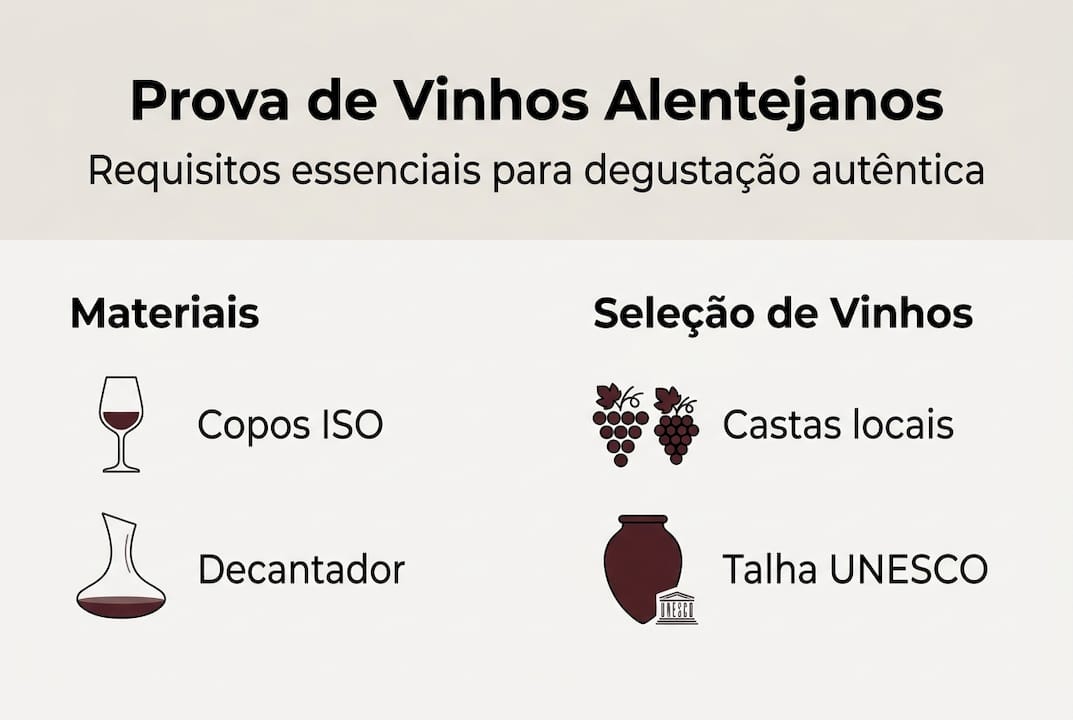
The tasting location deserves equal attention. Choose a well-ventilated space, free from competing aromas like perfumes, candles, or strongly scented food. The ideal ambient temperature is between 18 and 22 degrees Celsius. A table with a white background or a light-coloured tablecloth allows you to observe the wines' colour accurately.
Essential materials checklist:
- Approved ISO glasses, one per wine per participant
- Still mineral water to cleanse the palate
- Neutral bread or water crackers
- White background for visual analysis
- Tasting sheet for each participant
- Spittoon (essential for tastings with many samples)
- Pen or pencil for notes
To help you better understand the differences between a professional tasting and a home tasting, here is a useful comparison:
| Element | Professional tasting | Home tasting |
|---|---|---|
| Glasses | Certified ISO mandatory | ISO recommended |
| Number of wines | 6 to 12 samples | 3 to 6 samples |
| Evaluation sheets | Standardised (e.g., 100 points) | Free or simplified |
| Environment | Controlled neutral room | Clean and ventilated room |
| Moderator | Oenologist or sommelier | Informed host |
| Spittoon | Mandatory | Recommended |
If you're looking for inspiration to discover producers and regions, an Alentejo wine itinerary can help you understand which sub-regions have the strongest expression for each grape variety.
Step-by-step: structure and order for tasting Alentejo wines
With the environment ready and wines selected, it's important to structure the tasting to ensure clarity and appreciation for each sample. The order is not random. It is a sensory progression designed to protect your palate and reveal the best of each bottle.
Structure the tasting in increasing order of intensity, starting with lighter whites and finishing with fuller-bodied reds. Limit the session to 3 to 5 wines to avoid palate fatigue. More than that, and the palate begins to lose sensitivity, compromising the evaluation.
Serving temperatures are crucial. Whites such as Antão Vaz are served between 10 and 12 degrees. Young reds are good between 14 and 16 degrees, while aged reds require 16 to 18 degrees. Serving a wine too cold or too hot hides its aromas and unbalances the gustatory perception.
Recommended tasting sequence:
- Sparkling or Vinho Verde wines (if included)
- Light and fresh whites (Arinto, Roupeiro)
- Fuller-bodied whites with wood ageing (Antão Vaz)
- Alentejo rosés
- Young and fruity reds (Aragonez, Castelão)
- Medium-bodied reds (Trincadeira)
- Full-bodied and aged reds (Alicante Bouschet)
Pro Tip: Try a blind tasting by covering the labels with aluminum foil or opaque bags. It eliminates preconceptions about brands and prices, and the results are always surprising. The Lower Alentejo was named European Wine City 2026, with events like Ovibeja incorporating blind tastings into the official program.
If you want to deepen your technique before the tasting, learn how to taste wine like a pro and check out tasting tips that make the difference between a common tasting and a memorable experience. For a more comprehensive perspective, wine tasting guides in English also offer useful context.
Sensory methodology: visual, olfactory, and gustatory evaluation techniques
After defining the tasting order, it is essential to know how to evaluate each wine with rigorous methodology. Sensory analysis is divided into three distinct phases, each revealing different layers of the wine.

Visual phase
Tilt the glass against a white background and observe the colour, clarity, and viscosity. A young Alicante Bouschet will show a deep ruby, almost opaque. A well-made Antão Vaz will shine with golden hues and green reflections. The presence of sediment or turbidity may indicate aging or a technical fault.
Olfactory phase
Bring your nose close to the glass without swirling first. Identify the primary aromas, which come from the grape: fruits, flowers, herbs. Then gently swirl and smell again to reveal secondary aromas, related to fermentation, such as yeast or butter. Tertiary aromas emerge with aging: spices, tobacco, leather, vanilla.
Gustatory phase
Follow the standard sensory methodology with ISO glasses, water, and neutral bread between samples. On the palate, assess the acidity, tannins (in reds), body, balance, and the persistence of flavour after swallowing or spitting. A good Alentejo wine has a long finish and a balance between fruit and structure.
Elements to record on the tasting sheet:
- Colour and visual intensity
- Clarity (clear, cloudy, with sediment)
- Dominant aromas and complexity
- Acidity (low, medium, high)
- Tannins (soft, firm, astringent)
- Body (light, medium, full-bodied)
- Persistence (short, medium, long)
- Overall score
Pro Tip: Eat a piece of neutral bread and drink water between each wine. This simple ritual cleanses the palate and prevents the flavours of one wine from contaminating the evaluation of the next. To learn how to assess the quality of a wine in more detail, or to master wine terms for wine lovers, these resources are an excellent starting point.
Vinho de talha, a UNESCO-recognised tradition, deserves special attention in the tasting. Its aromatic profile is radically different from wines made in stainless steel or wood, with earthy, oxidative, and dried fruit notes that surprise those who taste them for the first time. Include at least one in your tasting to represent Alentejo's oldest heritage. Also, consult a wine scoring guide to systematise your evaluations.
Authenticity and regional nuances: how to value Alentejo's terroir
While mastering the technical aspect, there's a crucial element: appreciating the terroir and the nuances that make Alentejo unique. The soil speaks in the glass, and knowing how to listen to it is what separates a common tasting from a truly Alentejan experience.
The Alentejo terroir is diverse. Schist soils, found in areas like Portalegre, produce wines with higher acidity and freshness, which are more elegant and mineral. Limestone and marl soils, typical of Central Alentejo, yield wines with more body, ripe fruit, and rounder tannins. Recognising these differences during the tasting is a fascinating exercise.
How to identify regional nuances in the tasting:
- Compare wines of the same grape variety from different sub-regions (e.g., Aragonez from Portalegre vs. Aragonez from Évora)
- Pay attention to acidity: altitude wines have more freshness
- Observe the colour: poorer soils produce wines with less pigmentation
- Identify garrigue aromas (Mediterranean herbs) typical of Alentejo
- Note the texture of the tannins: clay soils tend to produce silkier tannins
"Alentejo is a wine nation, but it is constantly being reformed. New grape varieties, wineries, and techniques show that the region has not rested on its fame."
Alentejo has evolved with new grape varieties and techniques, presenting increasingly elegant wines with greater aging potential. Early harvests to preserve acidity, temperature control during fermentation, and judicious use of wood are trends that have transformed the profile of Alentejo wines in the last decade.
Local food pairings also enrich the tasting. Serve cured sheep's cheese with Antão Vaz whites, Alentejo "chouriço" (cured sausage) with Trincadeira reds, and "migas" (bread and pork dish) or black pork with a full-bodied Alicante Bouschet. Regional food amplifies the wine's characteristics and grounds the tasting in the territory's identity. The UNESCO-highlighted "vinho de talha" pairs surprisingly well with cured meats and Alentejo bread, creating a tasting experience with centuries of history.
What truly distinguishes an authentic Alentejo wine tasting
Beyond the technique and selected wines, there's a personal perspective on what makes a truly authentic tasting. And that perspective begins before opening the first bottle.
Authenticity isn't just about the list of selected wines. It's in the small decisions: respecting regional identity by avoiding international grape varieties in a tasting dedicated to Alentejo, ensuring an environment free of artificial aromas, and creating a space where every participant feels present in the experience, not just observing.
Many tastings fail by ignoring "vinho de talha" and less commercial grape varieties like Castelão or Roupeiro. These wines are often the most revealing of Alentejo's soul, precisely because they were not shaped to please the global market.
Prioritising producers with sustainable practices and pairings with local products transforms a wine tasting into a moment of cultural identity. The person organising the tasting plays a decisive role: their demeanor, enthusiasm, and shared knowledge make all the difference. Discover more about the secrets of tasting that make every tasting a lasting memory.
Explore more: experiences, itineraries, and tips for wine lovers
After understanding how to create an authentic tasting, discover where you can further deepen your experience.

Xico Sabido has resources designed for those who want to go beyond the glass. If you want to plan a visit to the region, the Alentejo wine route guides you through the 10 best places in the region. To better understand the grape variety that best represents Alentejo in international markets, delve into the history of Alicante Bouschet in Alentejo. And if you want to understand what lies beneath each bottle, the page on terroir culture and tradition is essential reading. The Xico Sabido community, the Compinchas, is always ready to share this passion with you.
Frequently asked questions
What is the ideal number of wines for a home tasting?
Between 3 and 5 wines per session are recommended to avoid palate fatigue and ensure a detailed and focused evaluation of each sample.
How to avoid the influence of extraneous aromas during the tasting?
The environment should be neutral, without perfumes or candles, with adequate ventilation and all materials clean, so that the wine's aromas are the sole focus of the experience.
Is it relevant to include "vinho de talha" in an Alentejo tasting?
Yes. "Vinho de talha", a UNESCO tradition, is essential to highlight Alentejo's authenticity and offers a unique sensory profile that no other winemaking method replicates.
What materials are essential for a wine tasting?
ISO glasses, water, and plain bread are the cornerstones of any serious tasting, complemented by a tasting sheet, a white background, and a spittoon for sessions with multiple samples.
Recommendation
- Alentejo Wine Route: the 10 best places - Xico Sabido
- Alentejo Terroir: Wines, Culture, and Tradition - Xico Sabido
- The Grape Varieties of Alentejo with Xico Sabido - Xico Sabido
- How to Taste Wine Like a Professional - Xico Sabido
- How to identify unique and authentic artisanal liqueurs – Mezzanotte | Distilleria & Spirits