

Explanation of bottle aging: myths and reality
TL;DR:
- Not all wines improve with age; only those with adequate structure, acidity, and tannins benefit from long periods in the bottle.
- Chemical aging occurs inside the bottle, forming tertiary aromas, altered color, and sediment through slow, controlled oxidation.
There's an almost universal belief among those beginning to appreciate wine: the older, the better. The idea is seductive. A bottle kept for years in a dark cellar seems destined for inexplicable greatness. But the explanation of bottle aging is far more nuanced than that. The process involves chemistry, storage conditions, the wine's own structure, and often, a good dose of luck. In this article, we'll debunk myths, explore what actually happens inside the bottle over time, and give you practical tools to decide when to store and when to open.
Table of Contents
- Key Points
- What Happens During Bottle Aging
- Factors Influencing Wine Aging
- Traditional Cellar vs. Submarine Aging
- Not All Wines Age Well
- Storing and Enjoying at Home
- My Honest Perspective on Aging Wine
- Alentejo Wines Made to Last
- FAQ
Key Points
| Point | Details |
|---|---|
| Not all wine improves with time | Only wines with adequate tannin structure, acidity, and alcohol benefit from prolonged aging. |
| The process is chemical and controlled | Slow oxidation inside the bottle transforms aromas and softens tannins, creating complexity. |
| Storage is half the battle | Temperature between 10 and 15°C, adequate humidity, and absence of light are crucial for successful aging. |
| Sediments are a sign of maturation | The precipitation of tannins and pigments is natural and indicates healthy wine evolution. |
| Alternative methods exist and evolve | Submarine aging shows distinct results, with greater aromatic integration and smooth texture. |
What Happens During Bottle Aging
For those who truly want to understand the bottle aging process, the starting point is chemistry. When a bottle is corked, the wine doesn't freeze in time. It continues to evolve, slowly, thanks to the residual oxygen trapped in the space between the liquid and the cork.
This reduced oxygen allows for slow, controlled oxidation, which is the key to all the magic. Unlike the destructive oxidation that spoils an open wine in a few days, this is subtle, almost secret. It's what builds the so-called tertiary aromas, a world of sensations that didn't exist when the wine was young.
We're talking about notes of leather, tobacco, mushrooms, truffles, honey, and even soft tar. Aromas that emerge from the transformation of compounds present in young wine and only reveal themselves with patience.
Visually, the changes are also unmistakable. Red wines lose their vibrant violet color and take on brick and amber tones. White wines, which are greenish-yellow when young, become golden and eventually deep amber. And over time, sediments appear at the bottom of the bottle, resulting from the precipitation of tannins and pigments. Far from being a flaw, sediment formation is a sign that the wine has evolved.
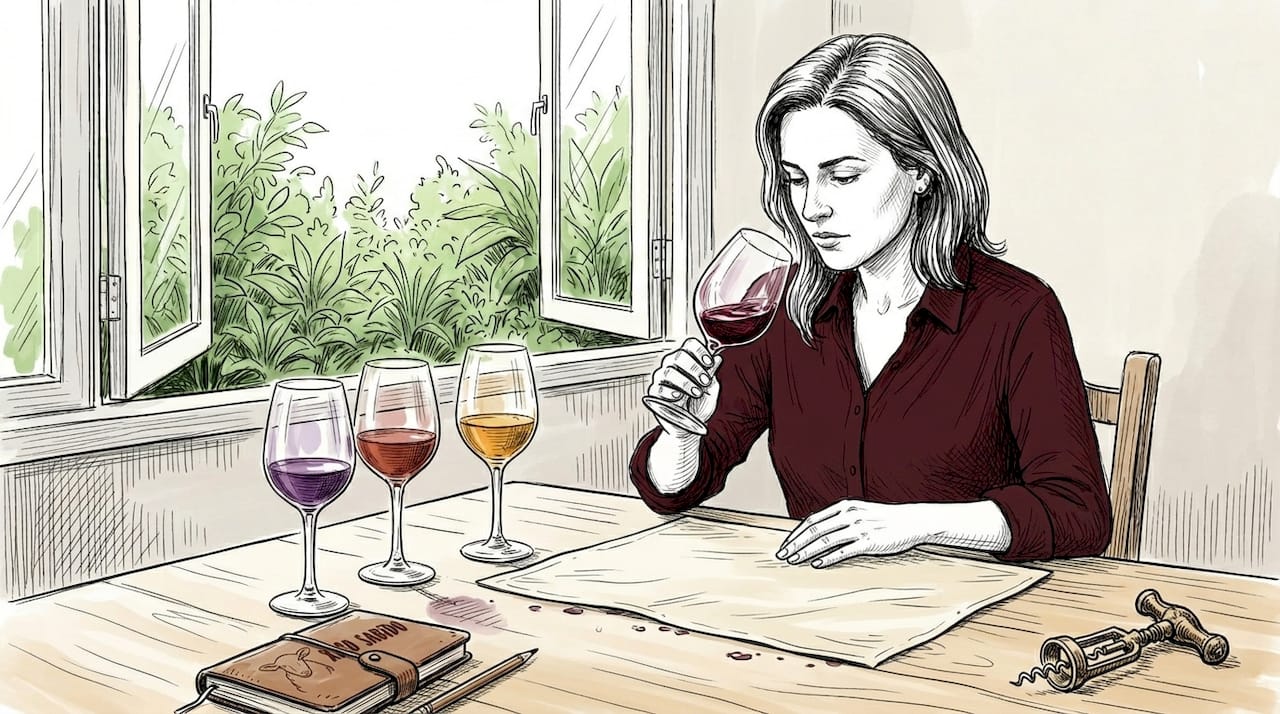
On the palate, the tannins that were once harsh and astringent undergo a profound transformation. It's not a simple polymerization, but a complex integration of tannins that results in a softer, silkier, and more harmonious texture. It's the difference between oak bark and silk fabric. Both come from the same tree, but they are different worlds to the touch.
It's also worth distinguishing between barrel aging and bottle aging. In the barrel, the wine receives oxygen more generously through the wooden staves and absorbs aromas like vanilla and spices. In the bottle, the process is much more closed, introspective. The wine stops receiving external influences and begins to work with what it has within itself.
Pro Tip: If you want to learn more about the technical terms that describe these transformations, the glossary of essential wine terms is a good travel companion.
Factors Influencing Wine Aging
Understanding how wine ages is only half the story. The other half is ensuring that the right conditions are met. Because a wine with enormous potential can be completely ruined by careless storage.
These are the factors that weigh most heavily on the success of bottle aging:
-
Stable temperature between 10 and 15°C. Ideal storage conditions require a constant temperature, without abrupt variations. Heat accelerates aging uncontrollably; excessive cold slows it down. Stability is worth more than absolute perfection.
-
Humidity between 60 and 80%. An overly dry environment dries out corks, allowing unwanted air in. An overly humid environment favors mold growth. Balance is essential.
-
Total absence of light. Direct light and heat degrade aromatic compounds and wine color with surprising speed. A dark cellar is not romanticism, it's a necessity.
-
Bottles in a horizontal position. Keeping the wine in contact with the cork prevents it from drying out and allowing excess oxygen to pass through. This is a simple but decisive rule.
-
Zero vibrations. Constant vibrations disturb the slow chemical processes that make aging work. A good cellar is a place of silence and stillness.
The structure of the wine itself is equally crucial. A wine without sufficient acidity, without firm tannins, or without alcoholic balance simply lacks the foundations necessary to evolve gracefully. As the saying goes in Alentejo: you don't build a good house on loose sand.
Pro Tip: If you don't have a cellar, a temperature-controlled wine fridge solves most problems. Avoid storing wine on top of the kitchen refrigerator, where engine heat is a silent enemy of any bottle.
Traditional Cellar vs. Submarine Aging
Bottle aging doesn't only happen in dark, cool cellars. In recent years, an alternative method has captured the wine world's attention: submarine aging. Bottles are submerged at the bottom of the sea, at depths ranging from 20 to 60 meters, for months or years.
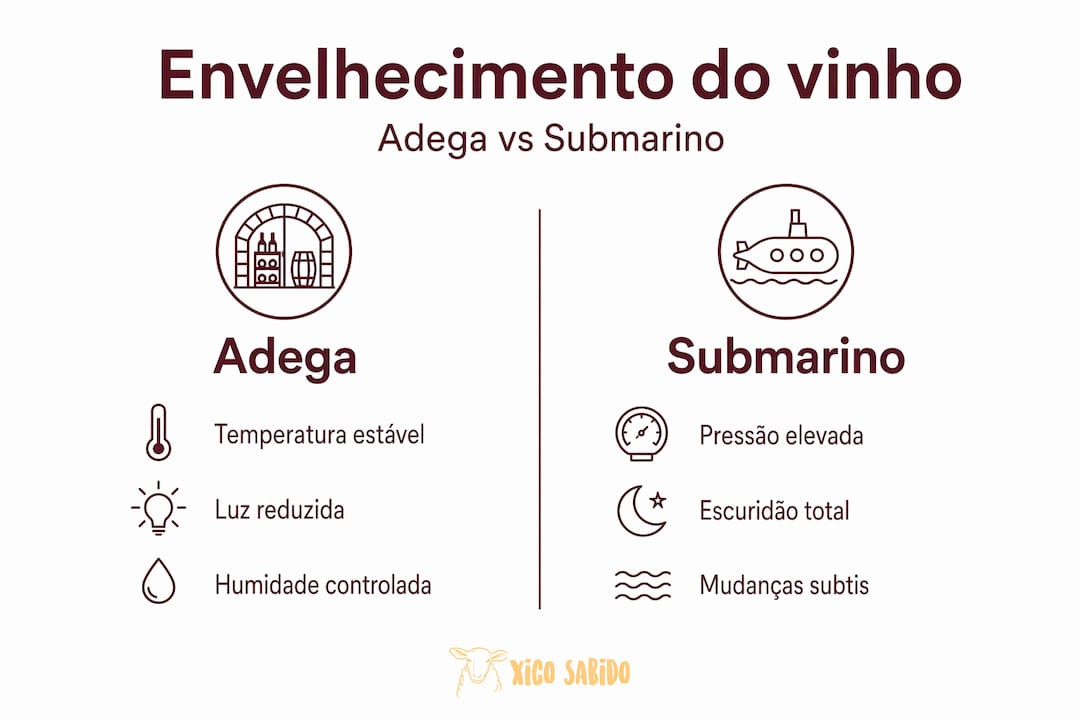
Experiments with submarine aging reveal subtle but fascinating changes. Constant pressure, absolute darkness, and stable temperature create unique conditions. Sea currents promote gentle and continuous movement, similar to the traditional bâtonnage that producers do in cellars. The result, according to those who have tasted it, is faster aromatic integration and a particularly velvety texture.
| Characteristic | Traditional Cellar | Submarine Aging |
|---|---|---|
| Temperature | 10 to 15°C, stable | Stable, generally 12 to 14°C |
| Light | Controlled absence | Absolute darkness |
| Movement | Static | Gentle current movement |
| Pressure | Normal atmospheric pressure | High and constant pressure |
| Sensory result | Classic complexity, defined tertiary aromas | Accelerated aromatic integration, smooth texture |
| Adoption | Millennial and universal | Experimental, growing in Italy and Spain |
Controversies exist. Some argue that the method is more marketing than science. But blind tasting results have surprised experts in several European regions, including Italian producers from the Ligurian coast and Spanish wineries from the Basque Country.
What is undeniable is that submarine aging opens new conversations about what it means to let a wine evolve and about the limits of what we consider tradition.
Not All Wines Age Well
This is perhaps the most important truth of this whole explanation: the vast majority of wines were not made to age. They were made to be drunk young, fresh, vibrant. And they are absolutely delicious that way.
Wines that truly benefit from long bottle aging share some characteristics:
- Firm and abundant tannins. These are what give the wine structure over time. Grape varieties like Aragonez, Alicante Bouschet, and Touriga Nacional in Alentejo have this natural muscle.
- High acidity. Acidity acts as a natural preservative. Wines with good acidity maintain their freshness even after years in the bottle.
- Balanced alcohol. Alcohol contributes to longevity, but in excess, it unbalances the whole.
- Initial concentration and complexity. A wine poor in aromas and structure will not gain what it doesn't have. Aging reveals what already exists, it doesn't create from scratch.
Contrary to popular myth, not all wines improve with age. There are good old bottles, and there are bottles simply spoiled by years of useless waiting. The difference lies in choosing wisely from the start. To delve deeper into this topic, you can explore how wine improves with time and what factors truly make a difference.
Personal taste also matters a lot. Some prefer the fruity exuberance of a young Alentejo wine. Others wait years to find that earthy, animal complexity that only time brings. Neither choice is wrong.
Storing and Enjoying at Home
Storing wine at home doesn't require a 19th-century cellar. With some attention and few resources, it's possible to create the right conditions for a good bottle to evolve with dignity.
-
Choose the right place. An interior cabinet, away from heat sources and direct light, can work wonders. The goal is thermal stability, not glamour.
-
Keep bottles on their side. The cork in permanent contact with the wine is the only guarantee that it won't dry out. A dry cork is an open door for unwanted oxidation.
-
Monitor carefully. A simple, inexpensive thermometer tells you if conditions are reasonable. You don't need expensive technology to do this well.
-
Know when to open. An aged wine that begins to lose color significantly, whose aroma is flat, or that tastes like vinegar has passed its peak. Learn to recognize the signs of positive aging before opening a special bottle.
-
Always decant wines with sediment. Decanting separates the solid deposit from the liquid and allows the wine to breathe before serving. A simple gesture that completely transforms the experience.
Pro Tip: Open the aged bottle an hour before serving and taste after 15 minutes. Some wines open up progressively; others reach their peak quickly and begin to decline. Following this arc is one of the greatest satisfactions for serious wine lovers.
My Honest Perspective on Aging Wine
I've tasted many old wines. Some were otherworldly experiences, with that complexity that only time builds. Others were simply disappointing: expensive bottles that didn't survive careless storage or simply didn't have what it takes to evolve.
What I've learned over the years is that critic Robert Parker is right when he warns about the risks of storing wine indefinitely: it can become an expensive and unrewarding exercise. Not because aging is a scam, but because most bottles were not made for it and most places where we store wine don't have the right conditions.
My conviction is this: choose the wine well, store it carefully, and drink it at the right time. Time in the bottle is not automatic magic. It's an alliance between the quality of the wine, the storage conditions, and your patience as a drinker. When everything aligns, the result can be sublime. But if any element fails, the bottle will show no mercy.
There's something deeply Alentejan about this philosophy. The land teaches that seasons cannot be rushed. Wheat grows at its own pace, olives ripen when they want, and wine, stored with respect, tells a story that only time can write.
— Pedro
Alentejo Wines Made to Last
The wines produced in Alentejo have soul. Grape varieties like Alicante Bouschet, with their characteristic tannic richness, are natural candidates for bottle aging. At Xicosabido, each bottle is born from a conscious choice about what the land offers and what time can transform.

If you've come this far curious about which wines are worth keeping, discover how a wine truly becomes special and explore the stories behind our selections. At Xicosabido, we believe that the best wine is not necessarily the oldest. It's the one made with passion, stored with respect, and shared at the right moment.
FAQ
What is bottle aging explained?
Bottle aging is the process of chemical evolution of wine after bottling, where slow and controlled oxidation transforms aromas, color, and texture over time.
Do all wines improve with aging?
No. Only wines with a solid structure, firm tannins, and good acidity benefit from prolonged aging. Most wines are made to be consumed young.
What factors influence wine aging?
Stable temperature between 10 and 15°C, absence of light, adequate humidity, and the quality of the cork are the main factors determining the success of bottle aging.
What are tertiary aromas in aged wine?
These are aromas that arise exclusively from aging, such as leather, tobacco, mushrooms, and honey, resulting from the chemical transformation of the original compounds of young wine.
Are sediments in wine a sign of problems?
No. Sediments in aged wine are natural and indicate advanced maturation. Decant the wine before serving to separate them from the liquid.