

Practical Guide to Personalizing Wine Bottles with Authenticity
TL;DR:
- Personalizing wine bottles transforms a simple gesture into a piece with history, ideal for special occasions.
- For a professional result, it is essential to choose appropriate materials, respect legal requirements, and measure labels correctly.
There are times when an ordinary bottle of wine simply isn't enough. A wedding, a significant birthday, a dinner among friends that will forever be etched in memory — in these moments, what's on the table says a lot about the giver. Personalizing a bottle of wine is transforming a simple gesture into an object with soul, capable of telling a story even before the cork is removed. But between the idea and the professional result lies a path made of right choices: suitable materials, precise dimensions, and, when it comes to wine for sale, a set of legal obligations that cannot be ignored.
Index
- What are the requirements and materials for personalizing wine bottles?
- Step-by-step: how to design and apply personalized labels
- What the law says: mandatory labeling and tips for legal personalization
- How to respect regional identity: examples of Douro, Porto, and tradition
- The truth about personalizing bottles: between authenticity and legality
- Take personalization and wine further
- Frequently asked questions
Key Takeaways
| Point | Details |
|---|---|
| Right materials and measurements | The secret to professional personalization lies in the exact choice of label material and the perfect adjustment of its dimensions. |
| Mandatory regulations | Personalizing for sale requires compliance with legal labeling requirements, even in details like QR codes and letter size. |
| Valued regional identity | Aligning design and regional mentions with tradition increases the credibility and value of the personalized bottle. |
| Durability and finish | Waterproof labels and protective finishes ensure that the label withstands transport, humidity, and cold, maintaining its elegant appearance. |
What are the requirements and materials for personalizing wine bottles?
Now that you understand the emotional impact of this art, see the requirements and materials needed to get started on the right foot.
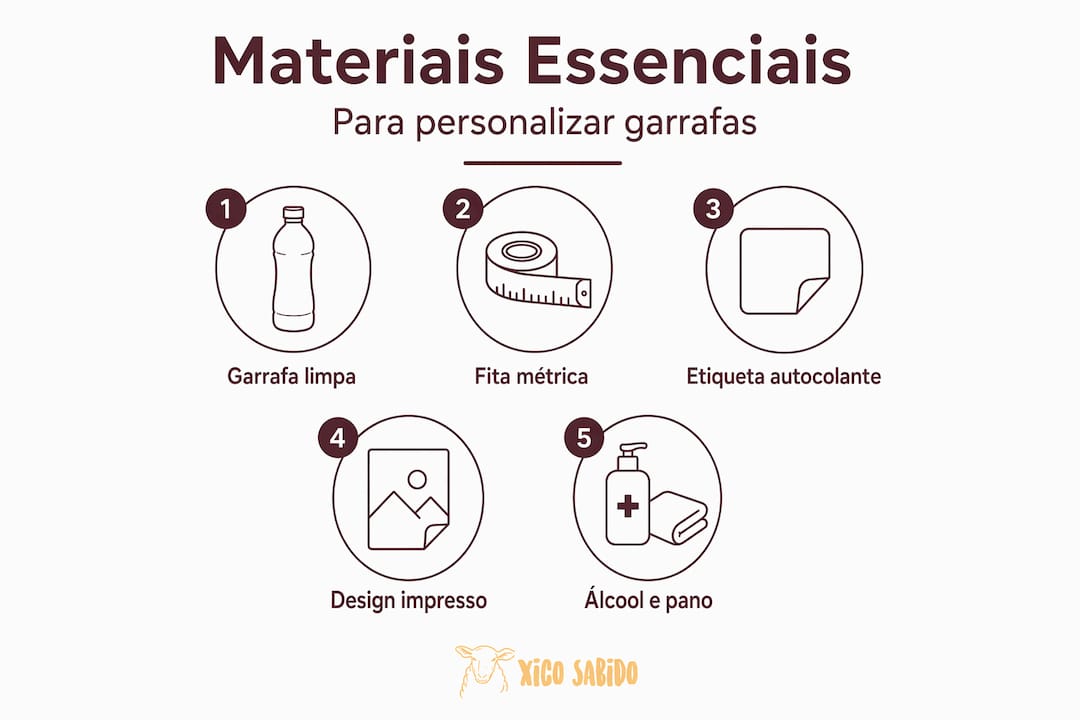
Personalizing wine bottles begins long before the design. It starts with choosing the right materials, understanding its intended purpose, and, above all, paying attention to the details that separate a homemade result from a truly professional one.
Essential materials to get started
The materials you'll need depend on the desired finish level, but there's a common base for any project:
- Wine bottle with a clean surface, free of grease or moisture
- Self-adhesive labels made of paper or film (vinyl, polyester, or BOPP)
- Printer inkjet or laser compatible with the chosen material, or a professional printing service
- Marker or glass paint for artisanal and unique customizations
- Protective film (glossy or matte laminate) for durability
- Surface cleaner to prepare the glass before application
The choice between paper and film makes all the difference. Paper is more economical and suitable for immediate use in dry environments. Meanwhile, film labels with a durable finish are waterproof, resistant to smudges, condensation, and heavy handling, making them the right choice for bottles that will go into ice or travel long distances.
Private vs. commercial use: differences that matter
This is a fundamental distinction. When you personalize a bottle to give to a friend or to decorate a wedding table with purchased wine, you have complete creative freedom. The design can be entirely free, with no legal content requirements.
When personalization is for wine that will be sold, everything changes. European and national labeling legislation comes into effect, imposing mandatory information on the label. More on this in the next section.
| Type of use | Design freedom | Legal requirements | Recommended material |
|---|---|---|---|
| Private (gift, event) | Total | None | Basic paper or vinyl |
| Commercial (sale) | Conditional | Yes, mandatory | Resistant vinyl/BOPP |
| Decorative (table, display) | Total | None | Any |
Pro Tip: Before choosing the design, measure the correct label dimensions for the specific bottle you'll be using. A poorly sized label creates bubbles, peels at the edges, and compromises all the work. The most common measurements for Bordeaux bottles are 90mm x 120mm for the main label and 90mm x 60mm for the back label.
Wine as a gift has a special emotional power, and personalization amplifies this power extraordinarily. But it only works when the final result looks thoughtfully crafted and cared for.
Step-by-step: how to design and apply personalized labels
With the materials ready, let's look at the process from design to final application.
Successfully personalizing a bottle is a process divided into well-defined phases. Skipping steps is the quickest way to a disappointing result.
1. Measure and choose the format
Always start with the bottle. Measure the circumference and available area for the label with a tape measure. Remember that the label cannot be so wide that it overlaps itself on the back. For standard 750ml bottles, a front label between 80mm and 100mm wide is generally safe.
2. Create the design
Use tools like Canva, Adobe Illustrator, or Photoshop. Set a minimum resolution of 300 DPI for quality printing. Include safety margins of at least 3mm on all sides to avoid unwanted cuts.
3. Choose the printing material
The choice of material and finish is as important as the design itself. A beautiful paper label that peels off at the first contact with cold loses all its charm.
| Material | Water resistance | Appearance | Cost | Ideal for |
|---|---|---|---|---|
| Matte paper | Low | Rustic, handmade | Low | Immediate use, dry environment |
| Glossy paper | Low | Bright, colorful | Low | Interior decoration |
| White vinyl | High | Sharp, modern | Medium | Bottles in ice |
| Transparent BOPP | Very high | "No label" effect | Medium/High | Premium presentations |
| Polyester | Very high | Elegant, durable | High | Commercial, export |
4. Print or order
For small quantities, home printing with self-adhesive paper is feasible. For truly professional results, especially when the influence of personalization goes beyond personal use, it's worth resorting to specialized printing services for glass labels.
5. Prepare and apply
Clean the bottle with isopropyl alcohol. Let it dry completely. Apply the label from top to bottom, pressing gently from the center outwards to avoid air bubbles. Use a card or rubber squeegee to smooth it out.
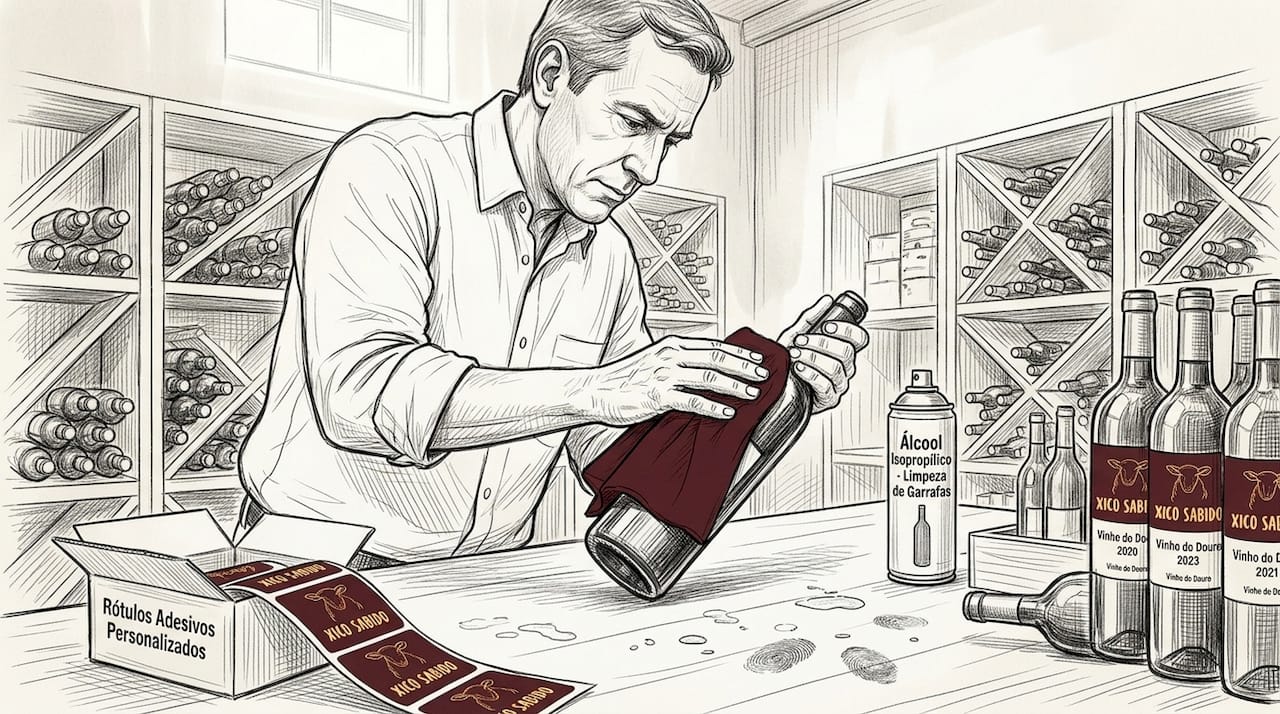
Pro Tip: Always apply at room temperature, between 18°C and 25°C. Very cold or very hot surfaces affect the initial adhesion of the adhesive and can compromise the final result.
What the law says: mandatory labeling and tips for legal personalization
After knowing how to apply it, it is important to ensure that the label does not violate current legislation.
The law is clear and, since 2023, more demanding. If you are creating a label for wine that will be placed on the market, there is information that simply cannot be missing, regardless of how beautiful the design is.
Mandatory information on wine labels
In Portugal and throughout the European Union, the legal requirements for wine labeling became stricter in 2023, with the obligation of new information:
- Sales designation (wine, sparkling wine, etc.)
- Protected geographical indication or designation of origin, where applicable
- Alcohol content in volume percentage
- Net quantity
- Country of origin or provenance
- Information on allergens (sulfites, eggs, milk)
- Batch number
- Name and address of the bottler
- List of ingredients (new for 2023)
- Nutritional declaration (new for 2023)
"The use of QR codes and electronic labels allows compliance with new nutritional declaration and ingredient list requirements without overloading the physical label, maintaining the bottle's aesthetic intact."
This is the big news for those who want to maintain a clean and elegant design. QR codes and electronic labels allow nutritional information and ingredient lists to be made available digitally, keeping the physical label looking premium. This solution is fully legal and increasingly used by producers who value the bottle's aesthetic as part of the experience.
Explore the legal details of the label before proceeding to mass production. And if you are working with national production, the requirements on the label vary according to the wine category.
For strictly private use, such as personalizing purchased wine bottles for a wedding or party, there is no legal obligation to include this information. All creativity is yours.
How to respect regional identity: examples of Douro, Porto, and tradition
By complying with the law, explore the value of regional authenticity in your personalized label.
Portugal is a country with deep wine origins, and each region carries a visual and cultural identity that deserves to be respected, especially when personalization involves protected designations.
Specific rules for Douro and Porto
The new labeling rules for Douro and Porto wines introduced very specific visual requirements that any producer or commercial personalizer must know:
- Minimum size of 3mm for the font used in mandatory mentions
- Visual proportion not less than 20% of the largest dimension of the brand/denomination
- Guaranteed legibility in all formats and containers
- Visual autonomy of the designation of origin in relation to other graphic elements
- Sufficient contrast between text and background for clear reading
These rules apply when the label explicitly mentions the denominations "Douro" or "Porto" as PDO (Protected Designation of Origin). These rules exist to protect the consumer and the integrity of the regions.
Personalization with regional identity
| Regional element | How to use authentically | Caution to be taken |
|---|---|---|
| Region name (Alentejo, Douro) | Visually highlight with legibility | Comply with minimum dimensions if PDO |
| Traditional grape varieties | Include on the label as a differentiator | Verify if mention is optional or mandatory |
| Local landscapes and symbols | Use as a central graphic element | Avoid elements protected by trademark |
| Historical references | Enrich the label's narrative | Do not create confusion with official denominations |
Personalization with regional references works very well when it is coherent. A label that mentions schist, xaras, or golden plains without being explicitly a PDO has full creative freedom to evoke the territory. However, when "Port Wine" or "Douro Wine" is mentioned with commercial intent, the rules above are non-negotiable.
Deepen your knowledge of Portuguese designations of origin before proceeding with any project involving protected geographical mentions. And if the regional terms of the wine world still seem complex to you, there are resources to help you navigate this universe with confidence.
The truth about personalizing bottles: between authenticity and legality
After delving into the practical and legal details, it is important to reflect on the choices made when personalizing.
There's a common illusion when it comes to personalizing wine bottles: the idea that a good design is enough for a perfect result. The reality is richer and, curiously, more interesting than that.
The biggest mistake made in this process is to focus all energy on the visual and forget everything else. A label with a stunning illustration, printed on thin paper that peels off on the second day in the fridge, is a failure. Similarly, a design conceived without considering legal obligations can turn a beautiful project into a real problem.
The truth about the impact of personalization lies in the details that no one sees at first: the material that withstands the journey, the adhesive that resists ice, the typography that is still readable after a night of partying. These invisible elements are what separate an amateur result from a result that impresses.
There is also a matter of cultural consistency that goes beyond the law. Personalising a bottle with images and references from a region implies respecting the spirit of that region. Putting a drawing of Alentejo vineyards on a Douro wine bottle creates an inconsistency that any connoisseur will notice. And this lack of authenticity does more harm than any technical fault.
Our conviction is clear: quality personalisation is a gesture of respect. Respect for the wine inside the bottle, for the region that created it, and for the person who will receive it. It is an act that begins with choosing the right materials, goes through compliance with the rules, and ends in an object that tells a true story.
Take personalisation and wine further
For those who want to advance their passion for personalised wine, new opportunities await.
Xico Sabido was born precisely from this desire to tell true stories through wine. Each bottle carries the soul of Alentejo, its red lands, the sun that warms the vines, and the passion of the people who work them. If you are looking for a wine that already has regional authenticity in its DNA, ready to be further personalised for your special moment, discover the Alentejo wines that Xico Sabido produces with care and identity.

Do you want to discover one of Alentejo's most fascinating grape varieties, one that produces wines of intense colour and unmistakable flavour? Get to know Alicante Bouschet, the red jewel of this region. Bottles with such personality are, in themselves, a memorable gift. With a custom label on top, they become unforgettable.
Frequently asked questions
Can I legally personalise a wine bottle for sale in Portugal?
You can, but you must ensure that the label complies with all current legal labelling requirements in Portugal and the EU, including mandatory information such as the ingredient list and nutritional declaration, which became mandatory in 2023.
What label size should I choose to personalise a wine bottle?
The ideal size depends on the bottle, but it is essential to measure beforehand and consult specific size references to ensure a perfect fit and professional appearance, starting with the correct dimensions before design.
Is it mandatory to use a QR code on the label for legal information?
A QR code is not mandatory but can be a practical solution for including nutritional information and ingredients while maintaining a clean design; including QR or e-labels is an elegant way to meet requirements without overloading the physical label.
Is it worth choosing waterproof materials for labels?
Yes, water-resistant materials and finishes ensure durability and a professional appearance; waterproof labels with a protective film resist scratches, fading, and stains, which is essential for bottles that go into ice or are transported.
Can personalisation include regional mentions such as Douro or Porto?
Yes, but specific dimension and proportion requirements must be met; rules for mandatory mentions include a minimum dimension of 3mm and a proportion not less than 20% of the largest dimension of the brand for wines with PDO Douro or Porto.