

Discover the best Alentejo white wines and how to choose them
TL;DR:
- Alentejo white wine stands out for its diversity of indigenous grape varieties and unique soils that give character to the region.
- For a quality choice, it is essential to analyze the terroir, the grape varieties, and the international recognition of the wine.
- Enjoying and pairing these wines with special moments reveals the essence of Alentejo tradition and innovation.
As the day draws to a close, the sun still warms the stones of the Alentejo, and the question almost inevitably arises: which white wine to open tonight? The shelf is full of beautiful bottles, the labels promise a lot, and the choice seems both a pleasure and a challenge. Alentejo is one of Portugal's richest and most unique wine regions, with a diversity of indigenous grape varieties, unique soils, and producers whose vineyards hold decades of knowledge. With the right criteria, making the right choice becomes not only possible, but genuinely rewarding.
Index
- How to choose a quality white wine
- Top 5 Alentejo white wines to try
- Comparison of white wines: tradition, innovation, and recognition
- Pairing suggestions and ideal occasions
- What experts almost never say about Alentejo white wine
- Discover, taste, and fall in love with Alentejo white wines with Xico Sabido
- Frequently asked questions about white wine
Key Takeaways
| Point | Details |
|---|---|
| Selection criteria | Terroir, indigenous grape varieties, and international distinctions are essential when selecting an Alentejo white wine. |
| Suggestion of award-winning wines | Labels like Quinta da Fonte Souto Branco and Luis Duarte Monte do Carrapatelo Reserva consistently receive high praise. |
| Quick comparison | Use tables to compare, side-by-side, aromatic profiles and accolades for each wine. |
| Perfect pairing | These wines pair well with seafood, fish, and even special outdoor moments. |
How to choose a quality white wine
Now that we know why this choice matters, let's understand the criteria for finding an above-average white wine.
The first pillar of any successful choice starts with terroir. In Alentejo, the schist, granite, and clay soils, combined with hot summers and cool nights, create unique conditions for white wines with character. The white wine production process directly influences the final aromatic profile, from fermentation temperature to the type of vessel used. Small differences in the cellar translate into completely distinct experiences in the glass.
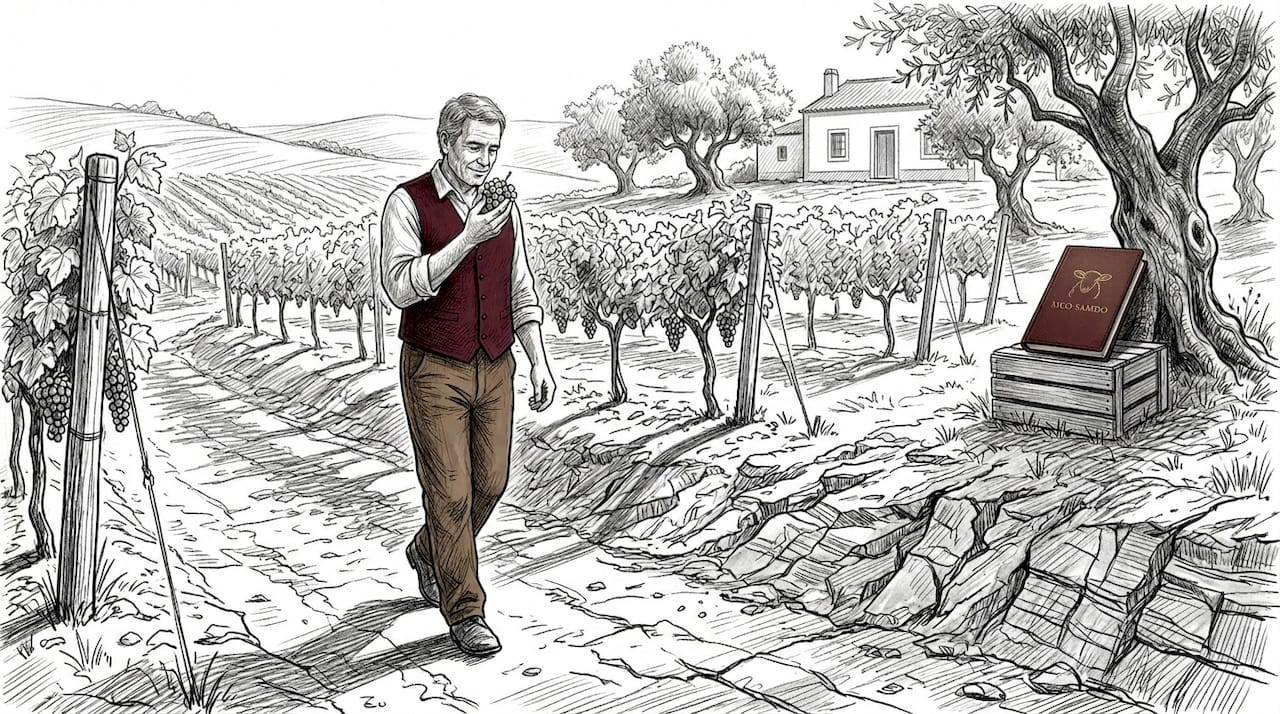
The Alentejo grape varieties are another determining factor. Antão Vaz, Arinto, and Roupeiro are the three major regional references, each with its own personality. Antão Vaz is full-bodied and tropical, Arinto is fresh and citrusy, and Roupeiro is delicate and floral. Knowing these differences helps anticipate what you'll find in the glass even before opening the bottle.
What the label tells you
Reading a label intelligently is a skill that is quickly learned. The essential elements to observe are:
- Region and sub-region: Portalegre, Évora, Reguengos, Vidigueira, each with its distinct microclimate
- Vintage year: younger wines tend to be fresher and fruitier, older vintages reveal complexity
- Producer's name: wineries with a consistent history of awards guarantee greater security in the choice
- Aging indication: "Reserva" or "Colheita Selecionada" (Selected Harvest) signal greater care in the production process
- Grape varieties present: blends of two or three grape varieties are often more complex than single varietals
International distinctions are another reliable sign. A wine like Quinta da Fonte Souto Branco 2023, which received 91 points from Decanter, or Luis Duarte Monte do Carrapatelo Reserva 2023, with 93 points from Wine Enthusiast, represent a tangible guarantee of quality recognized by demanding and independent juries.
Professional Tip: Try different vintages from the same producer. Comparing two vintages of the same wine reveals how each year's climate shapes the product's soul, and you learn a lot from this simple and tasty exercise.
Top 5 Alentejo white wines to try
Having defined the selection criteria, we now explore the most acclaimed options among Alentejo white wines.
Alentejo has an enviable list of whites that deserve attention. Between international award winners and lesser-known gems that whisper stories from the Portuguese interior, there's something for every taste and every occasion.
1. Quinta da Fonte Souto Branco 2023
Produced in the Portalegre sub-region, this wine received 91 points from Decanter, one of the world's most respected wine publications. The aromatic profile is elegant and mineral, with notes of citrus and aromatic herbs. It pairs beautifully with grilled fish, seafood rice, and fresh cheeses. Average price: between 12€ and 16€.
2. Luis Duarte Monte do Carrapatelo Reserva 2023
With 93 points from Wine Enthusiast, this reserve represents the best the Quinta da Fonte Souto Branco Alentejo Portalegre 2023 region produces in terms of complexity and structure. Notes of white peach, orange blossom, and a fine minerality that lingers on the finish. Ideal for more elaborate meals and celebratory moments. Average price: between 15€ and 20€.
3. Herdade do Esporão Reserva Branco
A classic that never disappoints. This wine from Herdade do Esporão primarily uses Antão Vaz and Arinto, resulting in a rich profile with vibrant acidity and tropical notes. It is one of the ambassadors of the wines of flavor and tradition of Alentejo, a constant presence on the tables of those who appreciate consistent quality. Average price: between 14€ and 18€.
4. Pêra Manca Branco
Considered by many to be the great reference white wine of Alentejo, Pêra Manca is produced at Herdade de Eugénio de Almeida. Made with Antão Vaz and Arinto, it undergoes barrel aging and has extraordinary longevity. It is a wine for special moments, capable of evolving wonderfully for years. Average price: between 35€ and 50€.
5. Mouchão Branco
Produced in one of the Alentejo's most historic wineries, this white has its own personality. The local grape varieties, treated with respect and without excessive technical intervention, result in a wine that seems to capture the essence of the scorching sun and serene nights of the Alentejo interior. Average price: between 10€ and 14€.
| Wine | Main Grape(s) | Score | Average Price |
|---|---|---|---|
| Quinta da Fonte Souto 2023 | Arinto, Antão Vaz | 91 pts Decanter | 12€ to 16€ |
| Luis Duarte Monte do Carrapatelo 2023 | Antão Vaz, Roupeiro | 93 pts Wine Enthusiast | 15€ to 20€ |
| Esporão Reserva Branco | Antão Vaz, Arinto | 90+ pts | 14€ to 18€ |
| Pêra Manca Branco | Antão Vaz, Arinto | 95+ pts | 35€ to 50€ |
| Mouchão Branco | Roupeiro, Antão Vaz | Highly rated | 10€ to 14€ |
"Alentejo white wine is not just a drink. It's a window into the soul of the land, where every sip tells a story of sun, stone, and passion."
Professional Tip: Buying directly from the producer, when possible, ensures freshness and a fairer price. Many small Alentejo producers sell online or welcome visits to their winery, which turns the purchase into a memorable experience.
Comparison of white wines: tradition, innovation, and recognition
After getting to know each wine, it's easier to directly compare their main characteristics to decide which one to try first.
Alentejo has the fortunate characteristic of offering, at the same time, wines of a more classic style and more contemporary expressions. Understanding where each one stands helps to choose with more confidence and less hesitation.
Tradition versus innovation: two complementary worlds
Wines of a more traditional style, such as Mouchão Branco or Pêra Manca, are produced using methods passed down through generations. They don't follow trends, they don't chase scores; they simply express the territory with honesty. These wines surprise with their authenticity and their ability to evolve over time.
Wines of a more innovative style, such as Monte do Carrapatelo Reserva or Esporão Reserva, combine indigenous grape varieties with updated cellar technology, controlled fermentation, and increased attention to the aromatic profile. The result is more immediate wines, more accessible to those starting to explore Alentejo whites.
| Characteristic | Classic Style | Modern Style |
|---|---|---|
| Aromatic profile | Mineral, austere, complex | Fruity, floral, tropical |
| Acidity | High and taut | Fresh and vibrant |
| Aging potential | High (5 to 15 years) | Medium (2 to 5 years) |
| Recognition | Historical prestige | Recent international awards |
| Pairing | Elaborate dishes, aged cheeses | Grilled fish, salads, appetizers |
International recognition plays an increasing role in purchasing decisions. When a jury of experts from London or New York awards a wine like Quinta da Fonte Souto Branco 91 points, or Monte do Carrapatelo 93 points in Wine Enthusiast, they are giving the consumer a reliable compass to navigate among so many options.
For pairing with Portuguese gastronomy, it's worth noting that:
- Wines with higher acidity, such as those based on Arinto, pair better with fatty fish dishes
- Fuller-bodied wines, with dominant Antão Vaz, better support dishes with creamy sauces
- Wines aged in wood gain expression alongside aged Alentejo cheeses
- Young, fresh whites are the perfect choice for seafood and summer salads
Pairing suggestions and ideal occasions
Knowing how to compare, it's time to align each wine with the perfect moment, whether it's a special meal or a spontaneous celebration.
The magic of white wine lies, in large part, in its versatility. There is no rigidity or absolute rules, but rather combinations that elevate the experience and transform a simple meal into a lasting memory. The perfect wine and food combinations are an invitation to experiment and discover what you like best.
Pairings that make sense
- Baked fish with an Esporão Reserva or Quinta da Fonte Souto: the wine's acidity cuts through the fish's fat and enhances the aromas of aromatic herbs
- Clams Bulhão Pato style with a young, citrusy white based on Arinto: the lemon and coriander in the recipe mirror the wine's notes
- Azeitão cheese with a Pêra Manca Branco: the cheese's creaminess finds its perfect counterpart in the taut, mineral acidity of this iconic wine
- Octopus salad with a Mouchão Branco: the octopus's texture and olive oil call for a wine with personality and freshness at the same time
- Codfish fritters at a summer picnic with a light, aromatic white: simplicity and pleasure in equal measure
Occasions that call for a good Alentejo white
- Summer lunches in the shade of an olive tree, where the wine's freshness contrasts with the afternoon heat
- Family celebrations where a plentiful table deserves a wine worthy of the shared joy
- Dinners for two with fresh fish and lit candles
- Entertaining friends at home with cheese and charcuterie boards, where a good white transforms the atmosphere
Regarding the ideal temperature, lighter Alentejo whites should be served between 8°C and 10°C, while reserves with more body and complexity gain expression between 10°C and 12°C. A wide-mouthed glass, like a Chardonnay glass, is best to allow the aromas to open elegantly.
The benefits of white wine go beyond sensory pleasure. In moderation, it fosters conviviality, strengthens bonds, and transforms ordinary meals into rituals of affection.
Professional Tip: Next time you have friends over for dinner, surprise them with two Alentejo whites of different styles at the same dinner. Live comparison is the best wine lesson there is, and it creates conversations that last late into the night.
What experts almost never say about Alentejo white wine
After the practical suggestions, it's worth taking a personal and curious look at what truly makes a difference in Alentejo white wine.
There is a truth that rarely appears in specialized critiques or in the technical sheets of international competitions: the best moments with Alentejo white wine happen outside the scores. They happen on an afternoon when a producer opens a bottle from a vintage that never made it to market and shares it as if offering a piece of their life story.
The value of personal connections with small producers is something no wine guide can fully capture. When you sit at a table in a winery in Portalegre and the producer himself tells you how that year's frost almost ruined the harvest, the wine in your glass gains an emotional dimension that no score can provide. The Alentejo wine route is, therefore, one of the most enriching experiences a wine lover can have.
Oral tradition still lives on in these lands. There are production techniques passed down from parents to children that have never been written down, knowledge about the behavior of grape varieties in years of extreme drought that does not exist in any academic manual. This silent knowledge is often what separates a good wine from a truly unforgettable one.
Emotion and memory play a role that enology science has not yet been able to quantify. The white wine you drink at a family lunch on an August afternoon in Alentejo will always taste better than the same wine drunk alone in a cold kitchen. Context is part of the recipe. Joy is an ingredient that doesn't appear on the label.
Therefore, the best choice is not always the highest-scoring one. Sometimes it's the wine a friend recommended, produced at a winery you've never seen referenced in a magazine. Sometimes it's a bottle that cost eight euros and, in the right company, surpassed all the rest. Alentejo has that rare gift of making the extraordinary fit into a simple bottle, produced with genuine passion and without pretensions of grandeur.
Discover, taste, and fall in love with Alentejo white wines with Xico Sabido
If you want to go beyond theory and bring these aromas and traditions into your home, there are straightforward ways to do so.
Xico Sabido was created precisely to make Alentejo wine accessible, authentic, and close to those who appreciate it, no matter where they are. You can buy Alentejo wine directly, with a guarantee of quality and the story behind each bottle.

To deepen your knowledge, there is content about the white wine production process that will surprise you, from the harvest to the moment the wine reaches your glass. And if your dream is to visit the region in person, the Alentejo wine route is the perfect starting point. Each bottle is an invitation. Accept it with pleasure.
Frequently asked questions about white wine
What are the best grape varieties for white wine in Alentejo?
The Antão Vaz, Arinto, and Roupeiro grape varieties are the most used for quality white wine in the region, each with distinct aromatic profiles that complement each other in elegant blends.
What makes an award-winning Alentejo white wine?
The combination of unique terroir, indigenous grape varieties, and producer innovation results in wines recognized by international juries, such as Quinta da Fonte Souto Branco 2023 with 91 points in Decanter and Luis Duarte Monte do Carrapatelo Reserva 2023 with 93 points in Wine Enthusiast.
How should I store white wine after opening?
It should be kept in the refrigerator, well corked, and consumed within three days to maintain the freshness, aromas, and balance that make it so special.
What is the right temperature to serve white wine?
The ideal is to serve between 8°C and 12°C, depending on the body of the wine: lighter whites require a lower temperature, while reserves with more structure gain expression with a slight increase in temperature.