

What are disruptive wines: a guide for 2026
TL;DR:
- Disruptive wines challenge wine traditions with new categories, sensory styles, and consumption rituals.
- In Portugal, examples like Poças Fora da Série, Delância, and Nonsense Arinto Laranja show growing innovative energy in the market.
Disruptive wines are those that challenge established conventions of the wine world, whether through their sensory profile, the category they fall into, the consumption ritual they propose, or the way they communicate with the consumer. It's not about rejecting tradition, but about refusing to accept it as something closed and immutable. In Portugal, examples like Poças' Fora da Série range, Delância's botanical wines, and Adega de Borba's Nonsense Arinto Laranja show that wine disruption has deep local roots and growing energy. Understanding what disruptive wines are is, today, a way to understand where Portuguese wine is heading.
What are disruptive wines and what defines them?
Disruptive wines are an umbrella concept for wine products that cause "positive discomfort" to the consumer, challenging traditional categories without losing technical quality. The wine industry often uses the term unconventional wine or innovative wine as synonyms, but the word "disruptive" carries a more precise intention: to actively break with patterns, not just ignore them.
To recognize a disruptive wine, look for variations across three simultaneous axes: unprecedented categories, consumption rituals outside the classic, and explicit technical objectives that break stylistic or presentation patterns. A wine can be disruptive on a single axis or all three at once. The more axes it challenges, the deeper its disruption.
Disruption is not synonymous with eccentricity. An orange wine produced with technical rigor, which presents unique texture and phenolic complexity, is disruptive because it alters the consumer's expectations of what a white wine can be. A NoLo wine (low or no alcohol) that preserves the structure and acidity of the base wine is disruptive because it challenges the idea that alcohol is inseparable from the wine experience.
The four dimensions of wine disruption
Wines that break rules generally do so on four distinct fronts:
- Sensory disruption: styles outside the norm such as orange wines, extended maceration wines, or wines with unexpected aromatic profiles for the grape variety. The consumer opens the bottle with one expectation and finds another reality in the glass, which can be unsettling or revealing.
- Categorical disruption: new categories such as NoLo wines, botanical wines, or sparkling wines from unprecedented grape varieties. Here, the product exists outside traditional legal classifications, which forces producers to create new language to communicate with the market.
- Ritual disruption: wines designed for aperitifs, informal sharing, or consumption away from the dining table. Delância, for example, created a new category of botanical wines specifically for aperitif culture, redefining the moment and context of consumption.
- Communication disruption: unexpected packaging, provocative names, visual narratives that break with classic wine aesthetics. This dimension is often underestimated, but it is the first to reach the consumer.
Pro Tip: If you find a wine you can't easily classify, that's a good sign you're looking at a disruptive wine. The difficulty of categorization is often its greatest virtue.
Disruptive wines vs. traditional wines: what changes in the glass
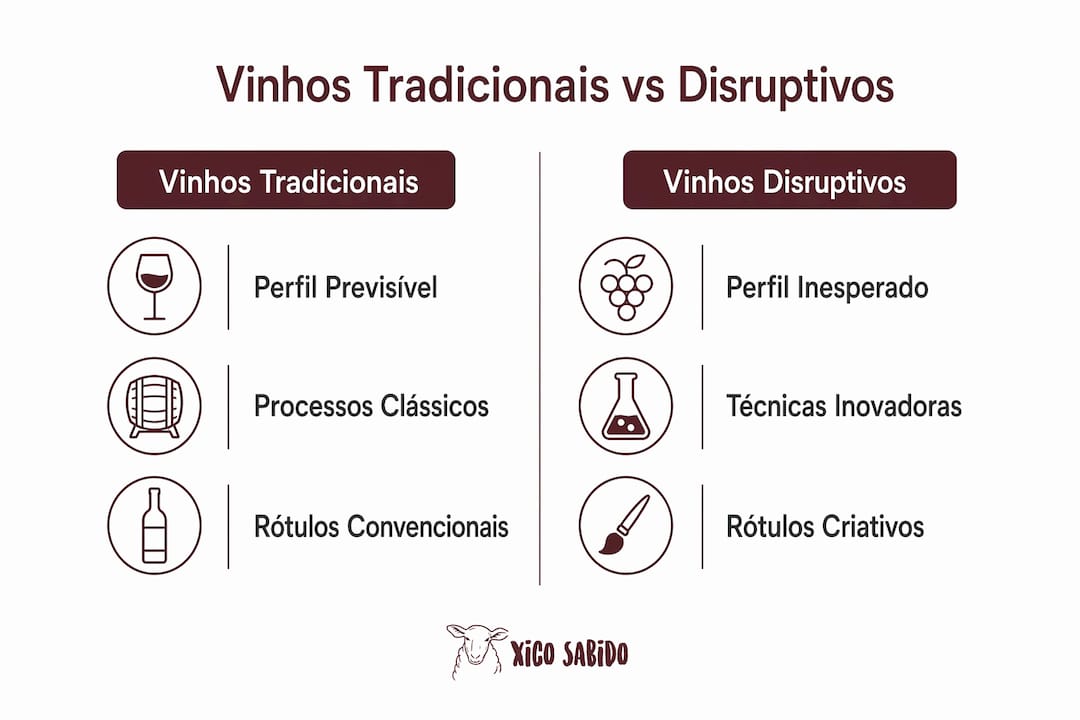
The difference between a disruptive wine and a traditional wine is not just philosophical. In the glass, the distinctions are concrete and, at times, surprising.

| Dimension | Traditional wine | Disruptive wine |
|---|---|---|
| Sensory profile | Predictable for the grape variety and region | Unexpected, challenges expectations |
| Legal category | Framed within classic PDO/PGI | Often outside established categories |
| Consumption ritual | Dining table, classic pairing | Aperitif, informal sharing, solo consumption |
| Communication | Classic label, technical language | Provocative visual, emotional narrative |
| Production technique | Established methods | Extended maceration, dealcoholization, botanical infusion |
Orange wines are the most visible example of this sensory difference. Produced with prolonged skin contact of white grapes, they present an amber color, present tannins, and a complexity that classic white wines do not have. The Nonsense Arinto Laranja from Adega de Borba is a perfect case study: it uses the Arinto grape, known for its fresh acidity and citrus profile, and transforms it into a wine with tannic structure and depth that surprises those who expect a conventional white.
NoLo wines present a different technical challenge. Techniques such as dealcoholization by reverse osmosis and partial fermentation try to preserve the structure and sensations of the base wine. The result is not an "amputated" wine, but a product with its own identity, where the absence of alcohol is a deliberate technical choice and not a limitation. This means that consumers need to recalibrate their expectations before evaluating.
The reaction of Portuguese consumers to these wines has been, in recent years, one of growing curiosity mixed with some resistance. Those accustomed to classic Alentejo or traditional Douro may feel initial strangeness. But it is precisely this strangeness that disruptive producers seek: not to annoy, but to provoke conversation and reflection.
How the Portuguese market has welcomed innovative wines
Portugal has been, surprisingly, fertile ground for wine disruption. The wealth of indigenous grape varieties, the diversity of terroirs, and a new generation of producers with advanced technical training have created the ideal conditions for experiments that go beyond the conventional.
-
Poças and the Fora da Série range. The Douro house launched a line of wines outside the classic Port categories, betting on positive discomfort as a driver of innovation. André Barbosa, responsible for the brand, describes the concept as a way to provoke consumers to question historical references without losing the link to the house's history. The result is wines that exist in a grey area between categories, which makes them difficult to classify and easy to remember.
-
Delância and botanical wines. This Alentejo project transformed a regulatory limitation into a creative opportunity. By operating outside traditional categories, Delância created a new language for the consumer, focused on modern celebrations and aperitif moments. The project was nominated in the innovation category of the V d’Or awards, which validates its relevance in the national wine scene.
-
Adega de Borba and Nonsense Arinto Laranja. Alentejo, a region known for its powerful reds and fresh whites, embraced the orange wine trend without hesitation. Nonsense is an example of how a cooperative winery can lead sensory disruption, using a local grape variety to create a product that divides opinions and generates conversation.
-
The new generation of Portuguese consumers. The more informed and autonomous consumer wants more than just liquid from wine. They want the story, the concept, the raison d'être. This change in mentality, coupled with a context of less table time and more informal sharing, creates a need for lighter, more social, and accessible wines. Disruptive wines respond precisely to this demand.
-
Sustainability and climate change. Climate change is forcing producers to experiment with heat-resistant grape varieties, alternative winemaking techniques, and viticultural approaches that reduce environmental impact. Many of these experiments naturally result in wines with unconventional profiles. Disruption, in this case, arises from necessity as much as from creativity.
What are the benefits and challenges of disruptive wines?
What you gain by exploring these wines
Disruptive wines bring real advantages, both for those who produce them and for those who drink them:
- Unique sensory experiences: each bottle is a discovery. The preserved phenolic complexity in NoLo wines or the tannic texture of orange wines offer consumers something that classic wines rarely provide: genuine surprise.
- Attracting new audiences: innovative wines reach consumers who have never been interested in traditional wine. Young adults, people who avoid alcohol for health reasons, or simply those seeking novelty find an entry point in these products.
- Sustainability: many disruptive wines arise from more environmentally friendly agricultural practices, using less chemical intervention and focusing on indigenous grape varieties better adapted to the local climate.
- Market differentiation: for producers, disruption is a way to stand out in a saturated market. A wine that generates conversation has a competitive advantage that no marketing budget can buy.
Obstacles you cannot ignore
Disruption comes at a price. The challenges are real and deserve attention:
- Resistance from the traditional market: sommeliers, distributors, and consumers accustomed to classic categories may reject products that do not fit their references. This resistance is cultural and takes time to change.
- Regulation: botanical wines like Delância's exist in a legal grey area that complicates their commercialization in some markets. The absence of clear legal categories is a real obstacle to international distribution.
- Demanding technique: dealcoholization by reverse osmosis and other advanced techniques require significant investment in equipment and knowledge. It's not enough to want to make a disruptive wine: you need the technical capacity to do it well.
- Effective communication: explaining to the consumer what is in the glass, without scaring or misleading them, is one of the biggest challenges. A beautiful label is not enough if the consumer doesn't understand what they are buying.
Pro Tip: If you are a producer and want to enter the world of disruptive wines, start with a single axis of disruption. Changing everything at once confuses the consumer and dilutes the message. Choose your angle, master it, and communicate it clearly.
Key points
Disruptive wines are defined by their ability to challenge categories, rituals, and sensory expectations without sacrificing technical quality.
| Point | Details |
|---|---|
| Clear definition | Wines that cause positive discomfort, challenging traditional categories and expectations. |
| Four axes of disruption | Sensory, categorical, consumption ritual, and communication are the dimensions that define disruption. |
| National examples | Poças Fora da Série, Delância, and Nonsense Arinto Laranja are Portuguese references for wine disruption. |
| Real benefits | New experiences, attracting different audiences, and market differentiation are the main advantages. |
| Concrete challenges | Cultural resistance, regulation, advanced technique, and effective communication are the central obstacles. |
Tradition is not a ceiling, it's a floor
There is a beautiful tension at the heart of disruptive wines. It's not the tension between old and new, as is sometimes simplified. It's the tension between what wine once was and what it still can be.
When I taste an orange wine from Alentejo, I don't feel like someone is destroying something. I feel like someone had the courage to take a grape variety that whispers centuries of stories and ask: what if we did it differently? That question, for me, is the heart of disruption. It's not irreverence for irreverence's sake. It's curiosity with technique.
What worries me, honestly, is superficial disruption. Provocative labels with mediocre wines, concepts without technical substance, innovation as a marketing strategy without roots in the terroir. That exists, and the attentive consumer learns to distinguish. A truly disruptive wine always has a raison d'être that goes beyond the packaging.
For the future of the Portuguese market, I believe that innovative wines will gain more and more space, not because tradition will lose, but because Portuguese consumers are becoming more curious and more demanding at the same time. They want to be surprised, but not deceived. They want adventure with substance. And that, in essence, is the best that wine can offer: the promise that every bottle can be a discovery.
If you haven't tried a quality orange, botanical, or NoLo wine yet, do it. Not necessarily to like it, but to understand where wine is going. Your palate of references will thank you.
— Pedro
Discover wines that tell new stories
Xicosabido was born in Alentejo with a simple mission: to bring wines with soul, history, and character directly to you. Curiosity for wines that break rules is part of the brand's DNA, because we believe that the most interesting wine is always the one that makes you think.

If this article has sparked your desire to explore unconventional wines, Xicosabido has selections that meet that curiosity. From indigenous Alentejo grape varieties with surprising profiles to small-batch productions that challenge expectations, there's always something new to discover. Start by exploring wines that have gone viral and understand what makes a wine unforgettable. Sensory adventure is just a click away.
FAQ
What is a disruptive wine, in simple terms?
A disruptive wine is one that challenges traditional consumer expectations, whether through its sensory profile, the category it falls into, or the consumption ritual it proposes. The concept includes orange wines, NoLo, botanical wines, and others that exist outside classic classifications.
Are orange wines always disruptive wines?
Orange wines should be evaluated not against classic whites, but against the producer's promise in terms of texture, complexity, and style. When produced with clear technical intent, they are disruptive wines by definition, as they radically alter the expected sensory profile for the grape variety.
Do NoLo wines have less quality than alcoholic wines?
Not necessarily. Alcohol removal with advanced techniques like reverse osmosis can preserve texture, acidity, and phenolic complexity, resulting in a product with its own identity and real quality. The difference lies in the technique used and the producer's intention.
How can I identify a disruptive wine on a shelf?
Look for wines that don't easily fit into usual categories, with labels that communicate differently or describe unusual winemaking processes. Names like "orange," "botanical," "alcohol-free," or references to prolonged maceration are clear clues. You can deepen your wine vocabulary by consulting essential wine terms to better understand what each description means.
Is Portugal a good market for disruptive wines?
Portugal has exceptional conditions for wine disruption, thanks to the diversity of indigenous grape varieties, the richness of terroirs, and a new generation of technically prepared producers. Examples like Poças, Delância, and Adega de Borba show that the national market not only welcomes innovation but is also leading it on several fronts.