

Wine ambassador recruitment steps
TL;DR:
- Recruiting wine ambassadors with genuine passion and commercial impact is a challenge that requires clear criteria and structured processes. Setting objectives, defining the ideal profile, and monitoring sales and reach metrics are essential for program success. Selection should prioritize authenticity, alignment of values, and an engaged audience, avoiding a focus solely on followers or superficial visits.
Recruiting wine ambassadors who truly move the needle is one of the biggest challenges producers and regional brands face today. There's no shortage of enthusiastic candidates, but finding someone with genuine passion, alignment of values, and the ability to generate concrete commercial returns is another story. The recruitment steps for wine ambassadors require much more than posting a job and waiting. They demand structure, clear criteria, and a process that filters enthusiasm from real impact. This guide shows exactly how to build that process, from scratch to the first signed contract.
Index
- Key Points
- Define Program Objectives and Structure
- The Ideal Wine Ambassador Profile
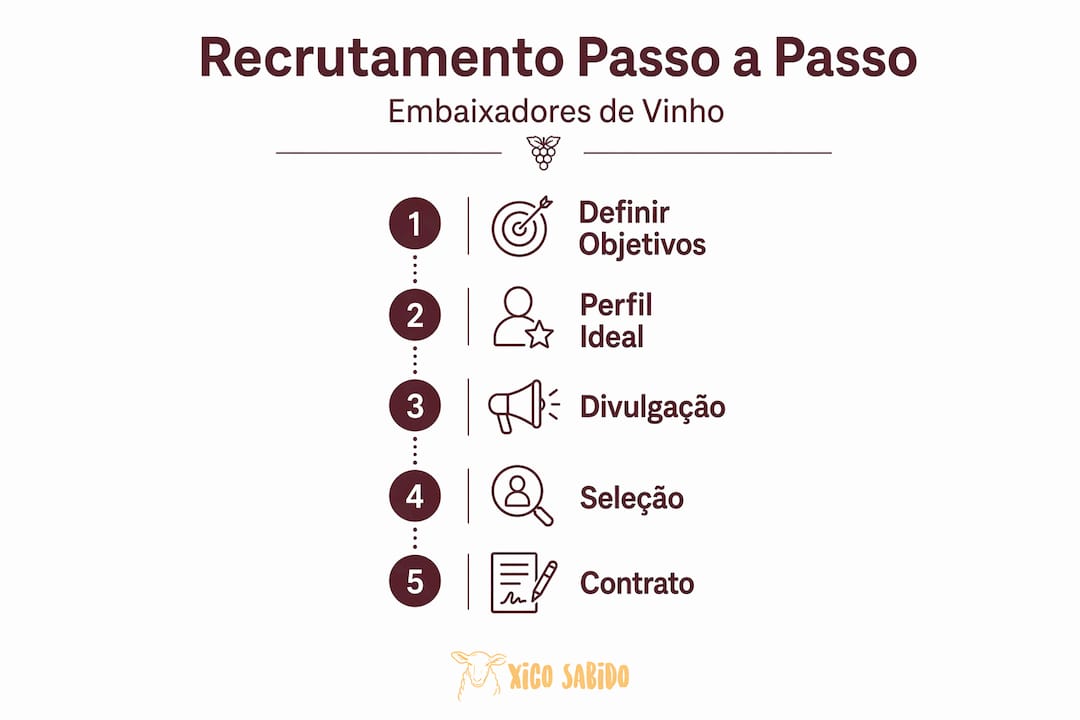
- Practical Recruitment Steps: From Outreach to Contract
- Managing Performance and Keeping Ambassadors Motivated
- Common Mistakes That Destroy Ambassador Programs
- My Vision on Ambassador Recruitment
- Discover Alentejo with Xicosabido
- FAQ
Key Points
| Point | Details |
|---|---|
| Define objectives before recruiting | Set concrete commercial goals before opening any ambassador positions. |
| Prioritize fit over followers | Ambassadors with genuine passion and small audiences often outperform profiles with many followers but little engagement. |
| Formalize with a contract from the beginning | A clear contract protects the brand and unequivocally sets expectations for both parties. |
| Measure commercial impact, not vanity | New listings, sales volume, and conversions are the indicators that justify the investment in the program. |
| Actively manage to retain talent | Regular follow-up and recognition of top ambassadors are crucial for the program's longevity. |
Define Program Objectives and Structure
Before posting a single job, you need to know what you want to achieve. It seems obvious, but most ambassador programs fail precisely here. Without defined objectives, recruitment becomes a random harvest.
Specific commercial objectives should guide the program from the outset. For example: securing 40 new listings in restaurants in 12 months, or growing the contact base by 2,000 people. These numbers are not arbitrary. They are the map that guides who to recruit, where to look, and how to evaluate success.
Alongside the objectives, it is necessary to define:
- The exact role of the ambassador: representation at events, prospecting new sales points, creating digital content, or a combination of the three.
- Expected weekly or monthly responsibilities, with clear and measurable deliverables.
- The compensation model. A fixed base structure with performance bonuses aligns the interests of both parties and promotes effort directed towards results.
- Non-financial incentives, such as early access to new batches, winery visits, or specialized training.
As important as the objectives is the support infrastructure. CRM and reporting systems should be operational before the program's launch. Successful programs use unique referral codes to attribute sales directly to each ambassador's actions, making ROI measurable from day one.
Professional Tip: Create a one-page document with the "program profile": objectives, role, compensation, and success metrics. Share it with all candidates before the interview. It saves time and filters out those who are not aligned right from the start.
The Ideal Wine Ambassador Profile
Here lies one of the industry's biggest mistakes: confusing visibility with value. A candidate with 80,000 followers on Instagram can generate less impact than someone with 4,000 loyal followers who genuinely trust their opinion on wine.

The wine ambassador selection process should begin by distinguishing formal credentials from commercial fit. A certified sommelier can be an asset, but if they lack communication skills or affinity with the brand's identity, the certificate is worth little in practice.
The criteria that truly matter are:
- Authentic passion for wine and the region. The ambassador's authenticity is essential for building trust with the public. If enthusiasm is faked, the public will sense it.
- Alignment with the brand's values. An ambassador representing a rural, artisanal brand must share those values, not just pretend to for a campaign.
- Oral and written communication skills. Practical tests during the selection process reveal more than any resume.
- Audience with real engagement. Nano and micro-influencers with up to 50,000 followers show significantly higher engagement rates and lower costs for niche campaigns.
- History and consistency with company values. Brand safety when choosing ambassadors includes analyzing the candidate's public history to avoid reputational risks.
To evaluate candidates practically, ask them to describe a wine they love and why. Observe whether they use learned technical language or tell a story with genuine emotion. The difference is immediate.
Professional Tip: Ask each candidate to share content they have already created about wine, even if informal. A well-framed photograph with a heartfelt caption says more about the ambassador's potential than any structured interview.
Practical Recruitment Steps: From Outreach to Contract
With objectives defined and the ideal profile outlined, it's time to attract qualified candidates. The process has four distinct phases.
-
Candidate sourcing. Use social media, online wine communities, sommelier groups, and the brand's own loyalty program. Those who already buy and speak well of the brand are natural candidates. Posting wine ambassador positions on platforms like LinkedIn or specialized Facebook groups can bring interesting profiles, but the best recruitment often comes from within the existing community.
-
Initial screening. Create an application form that includes open-ended questions about the candidate's relationship with wine, the region, and the brand. Analyze the answers, paying attention to how they communicate, not just the content. CRM tools allow efficient organization and comparison of candidates, avoiding intuitive decisions.
-
Interview and practical assessment. Conduct a 30-minute conversation focused on real scenarios: how would you present this wine at a dinner party? How would you respond to negative online feedback? Include a tasting test or simple content creation task to assess concrete skills.
-
Contract and onboarding. A formal contract is not bureaucracy. It is the foundation of the program. It defines deliverables, compensation, image rights, exclusivities, and exit conditions. It protects both the brand and the ambassador.
| Phase | Recommended Duration | Expected Outcome |
|---|---|---|
| Sourcing and form | 2 to 3 weeks | List of qualified candidates |
| Application screening | 1 week | Shortlist of 5 to 10 profiles |
| Interview and practical assessment | 1 to 2 weeks | 2 to 5 finalist candidates |
| Contract and onboarding | 1 week | Active and aligned ambassador |
Establish quick response cycles. Motivated candidates lose interest when the process takes too long. Responding to candidates within 48 hours is a practice that distinguishes organized programs from amateur ones.
Managing Performance and Keeping Ambassadors Motivated
Recruitment is just the beginning. Active program management is what transforms an enthusiastic ambassador into a lasting commercial asset.
Effective management is based on a regular rhythm of follow-up. Monthly meetings to review results, share brand news, and listen to ambassador feedback create a sense of belonging that no financial bonus can replace. Monthly performance monitoring and movement between incentive levels allow resources to be focused on the ambassadors who generate the greatest impact.
The metrics that truly matter in a wine ambassador program are:
- New listings secured in restaurants, stores, or digital platforms.
- Sales volume attributed through unique referral codes.
- Events held and participants reached.
- Conversion rate of the ambassador's communication actions.
- Growth of the brand's contact base.
Experienced professionals focus on commercial impact metrics, not just vanity. Likes and views are noise. Sales and listings are signals.
To keep the best ambassadors motivated, consider a tier system. Top ambassadors receive additional benefits: exclusive access to limited batches, invitations to private winery events, or a monthly restock of products for the top 10-20% most productive, which increases the frequency of organic content and the genuine integration of the brand into their daily lives.
| Level | Access Criteria | Benefits |
|---|---|---|
| Base Ambassador | Meets minimum monthly deliverables | Base commission, access to training |
| Silver Ambassador | Exceeds targets by 20% or more | Quarterly bonus, winery visit |
| Gold Ambassador | Top 10 to 20% of the program | Monthly restock, exclusive events, co-creation |
When an ambassador underperforms, the approach should be constructive. A direct conversation about what is going wrong, with concrete suggestions for improvement, resolves more than a formal email. Personalized campaigns to reactivate inactive members achieve success rates of 23 to 28%, much higher than generic blasts.
Professional Tip: Create a private messaging group exclusively for active ambassadors. Share winery news, harvest stories, and brand behind-the-scenes. This sense of community is worth more than any financial incentive to keep enthusiasm alive.
Common Mistakes That Destroy Ambassador Programs
Knowing the most frequent mistakes is as useful as knowing best practices. Some patterns repeat with alarming regularity.
- Improvising tracking after launch. Improvisation in results tracking is the biggest mistake you can make. Without metrics from the start, it's impossible to know what works.
- Choosing based on follower count. Recruiting ambassadors solely based on follower count, ignoring real engagement and brand affinity, is a recipe for budget waste.
- Not defining clear objectives. A program without goals is a program without direction. Ambassadors don't know what is expected of them, and the brand doesn't know if it's getting a return.
- Neglecting formal contracts. Verbal agreements create conflicts. A simple but clear contract protects both parties and defines what happens when things don't go as planned.
- Ignoring brand safety. An ambassador with a problematic public history can cause reputational damage that no campaign can repair.
"The best ambassador program in the world fails if it doesn't have a measurement structure from day one. You can't manage what you don't measure."
For those who want to delve into how to involve customers in wine selection and turn them into organic brand promoters, there are strategies that increase engagement by 40% and apply directly to ambassador recruitment.
My Vision on Ambassador Recruitment
Over the years I spent observing wine brands grow and stagnate, I learned one thing no manual directly teaches: an ambassador's genuine passion cannot be trained. It is found.
I've seen programs with generous budgets fail because they recruited profiles that looked brilliant on paper but were cold at heart. And I've seen small brands, with limited resources, build loyal communities because they found people who loved wine viscerally and authentically.
My most honest advice is this: don't rush. The wine ambassador selection process is slow by nature, and that's a good thing. Every misstep you filter out will cost you time, money, and reputation later on.
I also learned that managers who balance gifting and commissions are much more successful at retaining effective ambassadors than those who rely solely on payments. A special batch sent as a surprise on the ambassador's birthday does more for the relationship than a bank transfer.
The Portuguese wine market has a huge advantage that it hasn't seriously explored yet: the richness of regional stories. Alentejo, Douro, Dão. Each terroir whispers stories that a good ambassador can turn into conversations that sell. Those who know how to recruit with this criterion in mind will clearly differentiate themselves from the competition in the coming years.
— Pedro
Discover Alentejo with Xicosabido
If you've made it this far, you know that recruiting good ambassadors starts with a deep understanding of the product and the story it carries. At Xicosabido, we believe that every bottle of Alentejo wine is a silent ambassador of the land, the people, and the traditions that created it.

For those who want to understand what makes a wine truly viral and how to build a narrative that resonates with consumers and ambassadors, the article when a wine goes viral is a must-read. And to delve into the soul of the terroir that inspires our ambassadors, the guide on Alentejo terroir offers an insight that enriches any training program. Come and meet our community of Compinchas and discover how Alentejo reaches your table with all its soul.
FAQ
What is a wine ambassador program?
A wine ambassador program is an organized structure where individuals represent and promote a wine brand to consumers, points of sale, and events, in exchange for financial compensation, products, or other benefits.
How many followers does a wine ambassador need to have?
There is no mandatory minimum number. Nano and micro-influencers with up to 50,000 followers often generate more return than larger profiles, thanks to higher engagement rates and a trusting relationship with their audience.
How to effectively recruit wine ambassadors?
The process involves defining clear objectives, creating a detailed candidate profile, promoting in relevant communities, conducting interviews with practical assessment, and formalizing the agreement with a contract. The speed of response to candidates is also crucial for attracting the best profiles.
What metrics to use to evaluate wine ambassadors?
The most relevant metrics are new listings acquired, sales volume attributed via referral codes, events held, and conversion rate of communication actions. Vanity metrics such as likes or views have little value in isolation.
How to become a regional wine ambassador in Portugal?
To become a regional wine ambassador, the candidate must demonstrate a genuine passion for the region and the product, have authentic communication skills, align with the brand's values, and apply directly to wineries or through specialized platforms in the wine sector.