

Why low yields improve wine: the secret of the vineyard
TL;DR:
- Low yields concentrate essential phenolic compounds, elevating wine quality through careful management. This method improves colour, aroma, structure, and ageing potential, particularly in regions like Alentejo. In the current warmer climate, reducing production is a smart strategy to achieve balance and authenticity in the glass.
Low viticultural yields are the practice of limiting grape production per vine to concentrate essential phenolic compounds, which directly improves the colour, tannins, aromas, and expression of the terroir in the final wine. The answer to why low yields improve wine lies in the biology of the plant itself: when the vine carries fewer berries, it directs its resources to each one with much greater intensity. The result is a richer, more complex grape with a soul that the glass can convey. In Alentejo, where the scorching sun and poor soils naturally stress the vines, this principle takes on an almost poetic dimension.
Why low yields improve wine: the science of phenolics
Phenolic compounds are at the heart of red wine quality. Anthocyanins, tannins, and other polyphenols determine the colour, structure, longevity, and aromatic depth of each bottle. Scientific reviews confirm that fewer fruits per vine measurably increase the concentration of these compounds. This means that wine produced from low-yield vines tends to be more intense, more structured, and more true to its birthplace.
The agricultural logic is simple. The vine has a limited photosynthetic capacity. When it distributes that energy over many berries, each one receives less. When it concentrates everything into a few, each berry accumulates more sugar, more phenolics, and more aromatic precursors. The efficient allocation of the plant's resources is the true driving force behind quality.
But there's a nuance that many ignore: vine stress needs to be moderate. Severe stress harms phenolic balance, negatively affecting the wine's colour and structure. A vine under extreme suffering does not produce an extraordinary wine. It produces an unbalanced wine, with aggressive tannins and dull aromas.
Professional Tip: To achieve the ideal point of moderate stress, Alentejo viticulturists combine short pruning, cluster thinning mid-cycle, and careful irrigation management. It's not a single recipe. It's a constant conversation with the vineyard.
Practical tools for controlling yields include:
- Short pruning: reduces the number of buds and, consequently, clusters per vine
- Cluster thinning: manual removal of part of the production in mid-summer
- Canopy management: control of shade and sun exposure to balance maturation
- Controlled deficit irrigation: induces moderate water stress without compromising the plant
Canopy management, pruning, and irrigation are the key tools to achieve this balance in the field. Without them, talking about low yields is just theory.
How the current climate affects yields and wine quality
Global warming has changed the rules of the game in Portuguese vineyards. Climate change causes sugar maturation before phenolics and aromas, creating an imbalance that can be tasted in the glass. The most visible result is wines with alcohol levels of 14% to 15%, increasingly common in Portugal. High alcohol without equivalent phenolic structure produces hot, heavy wines lacking freshness.
In this context, reducing the production load per vine becomes a balancing tool. When the vine carries fewer berries, phenolic and aromatic maturation has more time and energy to keep up with sugar maturation. The balance between phenolics and sugars is now one of the biggest priorities for Portuguese producers who want to maintain regional identity in their wines.
However, there is a real risk that deserves attention:
- Excessively low yields in years of extreme heat can further accelerate maturation, concentrating sugars before phenolics reach their ideal point
- The early harvest caused by heat can be mitigated with low yields to favour phenol/aroma/acidity balance, but requires constant monitoring
- In regions like Alentejo, where summer temperatures regularly exceed 40ºC, the viticulturist needs to adjust the strategy year by year
The message is clear: low yields are an intelligent response to the current climate, but they are not an automatic solution. They require knowledge, observation, and permanent adaptation.
What changes in the winery and in the glass with low-yield wines
In the winery, the impact of low yields is felt concretely. Wines with higher phenolic content show a better volatile aroma profile and a richer sensory perception. Phenolic compounds interact with the wine's volatiles to intensify fruity and floral aromas, while creating a more enveloping mouthfeel. Anyone who has tasted an Aragonez or Alicante Bouschet wine from an old Alentejo vineyard knows exactly what we are talking about.
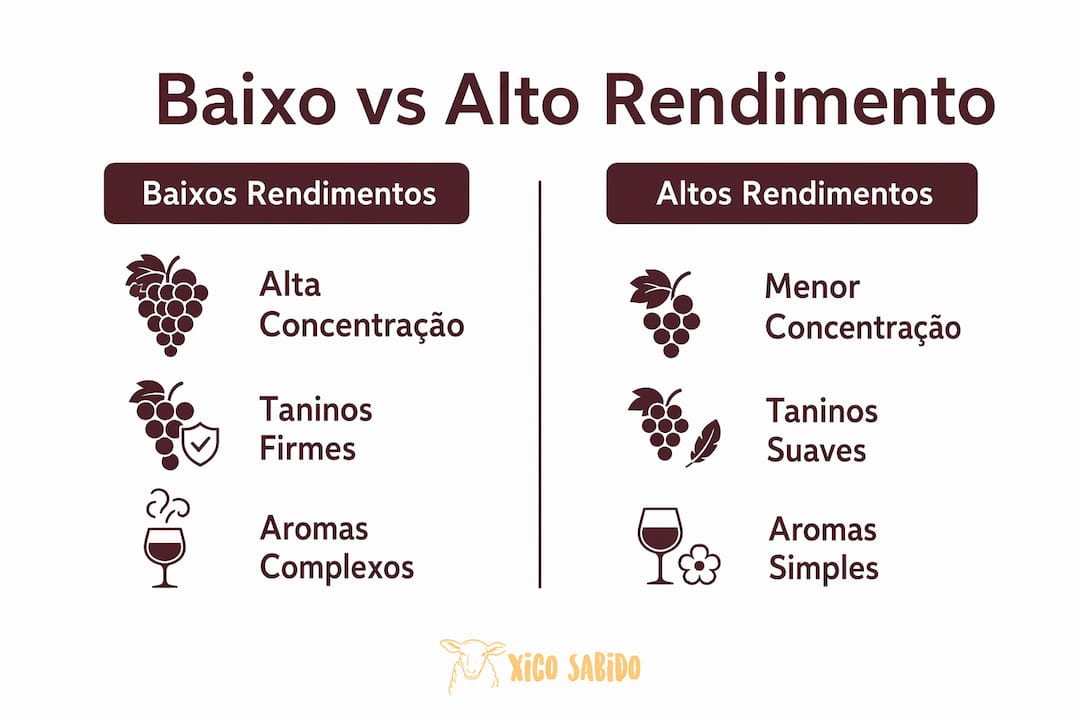
| Parameter | Low-yield wine | High-yield wine |
|---|---|---|
| Phenolic concentration | High | Low to moderate |
| Colour intensity | Deep and vibrant | Pale to medium |
| Tannic structure | Firm and silky | Light or diluted |
| Aromatic profile | Complex, fruity and floral | Simple, not very expressive |
| Ageing potential | High | Limited |
But concentration is not synonymous with automatic pleasure. High concentrations of phenolic compounds interact with the wine matrix in ways that can generate excessive bitterness or astringency if winemaking is not careful. The winemaker plays a decisive role here: extraction during maceration, the choice of barrel type, and ageing time are adjustments that transform potential into real pleasure.
Professional Tip: In low-yield wines with high tannic concentration, shorter macerations and controlled fermentation temperatures help preserve the fruit and soften the texture without losing structure. Less extraction, more elegance.
The final quality of the wine always depends on the interaction between the grape's phenolic profile and the enological techniques applied in the winery. An extraordinary grape poorly vinified is a lost opportunity. A good grape well worked can surprise. When both parts work in harmony, the result is a wine that tells the story of its birthplace, like those you can explore in the Alentejo wines that reflect exactly this balance.
Low yields versus high yields: what really changes?
The direct comparison between the two models reveals real differences, but also debunks some myths. Low-yield wines tend to be more concentrated, more structured, and have greater ageing potential. High-yield wines can dilute phenolic and aromatic characteristics, producing lighter and less expressive bottles. This is the general rule. But the rule has important exceptions.
Terroir and agricultural management are decisive in both cases. A well-managed vineyard with average yields, in poor soils and with adequate sun exposure, can produce wines superior to a poorly managed low-yield vineyard. Low yields do not automatically guarantee higher quality. Context always matters.
The main myths to debunk:
- "Less production is always better": false. Severe stress degrades phenolics and unbalances the wine
- "High yields always produce mediocre wine": false. In cool regions with rich soils, higher yields can produce balanced and fresh wines
- "Price always reflects yield": not always. The relationship between price and quality in wine is more complex than the label suggests
What is undeniable is that, in the conditions of Alentejo and a large part of southern Portugal, low yields combined with intelligent management and careful winemaking produce wines with a regional expression that terroir wines from other Iberian regions also recognize as a mark of identity. Phenolic concentration intensifies regional characteristics, strengthening the wine's identity and complexity in a way that no winery additive can replicate.
Key Points
Low yields improve wine because they concentrate essential phenolic compounds in the grape, provided that stress is moderate and agricultural and enological management are careful.
| Point | Details |
|---|---|
| Phenolic Concentration | Fewer berries per vine increase anthocyanins and tannins, improving colour and structure. |
| Moderate Stress | The benefit only exists with controlled stress; severe stress degrades quality. |
| Climate and Balance | Low yields help balance phenolic and sugar maturation in hot years. |
| Complementary Winemaking | High phenolic concentration requires adjustments in the winery to avoid bitterness and astringency. |
| Terroir as Context | Management and soil determine whether low yields translate into real quality. |
What I learned from looking at the Alentejo vineyards
There's one thing no book teaches you: the difference between a vineyard that suffers and a vineyard that fights. I spent years visiting producers in Alentejo and learned to distinguish between the two. The vineyard that suffers has yellow leaves, shriveled berries, and an air of abandonment. The vineyard that fights has deep roots, small and concentrated berries, and a silent energy that you feel when walking between the rows at dusk.
Low yields, when well managed, belong to the second category. They are not a punishment for the plant. They are a conscious choice that forces it to give its best. And that is seen in the glass with a clarity that continues to surprise me, even after so many years.
What worries me, honestly, is the warming. More and more producers I talk to feel that the rules have changed. What worked ten years ago no longer works the same way. Reducing yields remains one of the smartest responses, but it requires a finer reading of the vineyard, year by year, week by week. There is no formula. There is attention.
For wine consumers, understanding this reality changes the way they look at a bottle. A limited-production wine, from an old Alentejo vineyard, is not expensive out of whimsy. It is expensive because someone made difficult decisions in the vineyard so that what is in the glass has soul. It is worth knowing the essential wine terms to better read what is on the label and understand what is behind each choice.
— Pedro
Alentejo wines that tell this story in the bottle
At Xicosabido, curation begins in the vineyard. Every bottle that reaches our Compinchas has been chosen with attention to management, terroir, and the regional expression that only low yields and traditional Alentejo grape varieties can offer. We don't sell volume. We sell history, concentration, and authenticity.

If you want to explore wines that reflect everything you've just read, the starting point is our Alentejo wine route, where we gather the best places and producers who work with this philosophy. And if curiosity takes you further, also discover what makes some wines truly rare and exclusive. Quality always has an origin. Here, that origin has a name: Alentejo.
FAQ
What are low yields in viticulture?
Low yields refer to the production of a reduced quantity of grapes per vine or per hectare, achieved through pruning, cluster thinning, and canopy management. The goal is to concentrate phenolic and aromatic compounds in fewer berries, improving wine quality.
Do low yields always guarantee a better wine?
No. Studies confirm that severe stress impairs phenolic balance and can degrade quality. The real benefit occurs only with moderate stress, good agricultural management, and appropriate winemaking.
How does warm climate affect yields and wine quality?
Warming causes sugar maturation before phenolics, leading to wines with 14% to 15% alcohol levels and sensory imbalance. Reducing yields helps synchronize maturation and restore freshness and aromatic expression.
What is the difference between low-yield and high-yield wines in the glass?
Low-yield wines tend to have more intense colour, firmer tannins, more complex aromas, and greater ageing potential. High-yield wines are generally lighter, with less phenolic concentration and a simpler aromatic profile.
How to know if a wine was produced with low yields?
The information may appear on the back label or in the producer's data, often expressed in kilograms per vine or hectolitres per hectare. Limited production wines, from old vineyards or with controlled designation of origin, tend to follow low-yield practices due to regulation or producer philosophy.