

Why Unfiltered Wine? A Consumer Guide
TL;DR:
- Unfiltered wines represent a deliberate choice that values authenticity, terroir, and sensory complexity. Filtration, while offering stability, can remove aromas, textures, and nuances, leaving the wine poorer in character. Opting for unfiltered artisanal wines requires attention to service and greater dedication from the producer, reflecting a commitment to the genuine expression of the vineyard.
Some people look at a slightly cloudy glass of wine and think something went wrong. That the wine is spoiled. That the producer forgot a step. But the truth is quite the opposite. Understanding why unfiltered wine exists is to comprehend a deliberate, almost philosophical, choice that places authenticity above appearance. A cloudy wine can be the most honest wine you’ve ever poured into a glass. And in this article, Xicosabido explains why, without mincing words and with the passion of someone who knows the land well.
Index
- Key Points
- Why unfiltered wine: the process the industry hides
- The philosophy behind non-filtration
- What to expect in the glass: sediments, cloudiness, and aroma
- Filtered versus unfiltered: an honest comparison
- How to get the most out of an unfiltered wine
- My view: authenticity has no filter
- Discover Xicosabido's wines with Alentejo soul
- FAQ
Key points
| Point | Details |
|---|---|
| Cloudiness is not a defect | The cloudy appearance indicates minimal intervention and preservation of the grape's natural compounds. |
| Filtration removes complexity | The process ensures clarity but can eliminate aromas, texture, and sensory nuances of the wine. |
| Production requires more rigor | Unfiltered wines require healthier grapes and strict cellar control for stability. |
| Serving requires preparation | Resting and decanting are simple steps that transform the experience of drinking an unfiltered wine. |
| It's a conscious choice | Opting for artisanal unfiltered wine is to value terroir and tradition above industrial standardization. |
Why unfiltered wine: the process the industry hides
To understand why unfiltered wine exists as an option, it's essential to first understand what filtration does. And what it undoes.
Filtration is the process by which wine passes through one or more filtering media before being bottled. The objectives are clear: to remove suspended solids, eliminate undesirable microorganisms, and ensure a clear and crystalline appearance. For the conventional wine industry, filtration ensures microbiological stability and is considered indispensable, especially for large-volume and long-distribution wines.
The most common techniques include depth filters (which retain particles by absorption), membrane filters (with specific pore sizes to eliminate bacteria and yeasts), and plate filtration. Each method has different degrees of rigor, and the finer the filtration, the greater the intervention in the final product.
The problem lies precisely there. The industry uses filtration for a consistent product, but this process can reduce sensory complexity. Phenolic compounds, residual yeasts, and natural proteins that give texture and depth to the wine are retained in the filters. What reaches the glass is visually cleaner but can be poorer in character.
See the impact of filtration on wine through this comparison:
| Element | With filtration | Without filtration |
|---|---|---|
| Appearance | Clear and crystalline | Cloudy or slightly veiled |
| Aroma | More neutral, standardized | More expressive and complex |
| Texture | Lighter and linear | Fuller-bodied and enveloping |
| Shelf life | Longer, more stable | Requires controlled conditions |
| Intervention | High | Minimal |
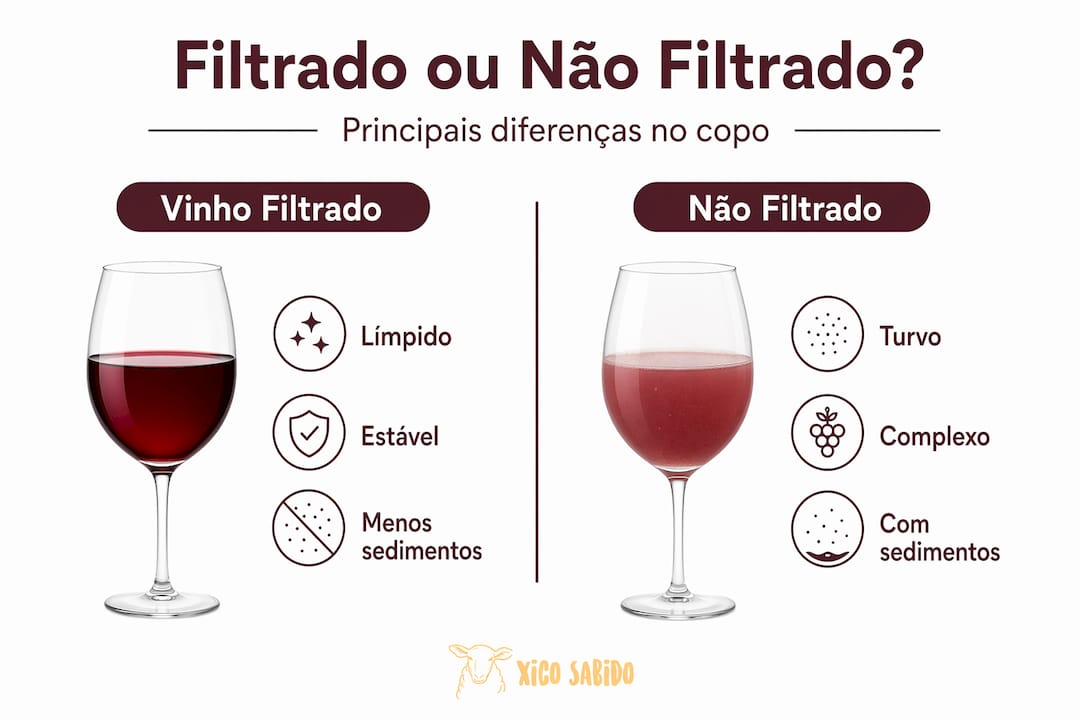
Filtration is not the enemy. It's a tool. What's worth questioning is when this tool starts being used for commercial convenience, not out of a real need for the wine.
The philosophy behind non-filtration
Some producers refuse to filter their wines. Not out of laziness or carelessness. But out of conviction.
The choice not to filter is a deliberate one for minimal intervention and preservation of the grape's essence and complexity. It's a stance born from a different relationship with the vineyard and the wine. The producer who chooses not to filter believes that the wine already carries everything it needs. That interfering too much is betraying the grape, the land, the vintage.
This philosophy is deeply connected to organic or biodynamic viticulture, which minimizes the use of additives and maintains process transparency. In natural wines, minimal intervention is not just a method. It's a statement of principles. The producer tells the consumer: “what is in this glass is exactly what happened in the vineyard and the cellar, without masks.”
But beware: not filtering is not easy. It means accepting greater risks. It means that any problem in the vineyard will be reflected in the glass, without a safety net. Producers who follow this path therefore work with:
- Rigorous selection of grapes at harvest, discarding fruits with any sign of disease or damage
- Exemplary hygiene in the cellar, because without filtration there is no second chance to correct contaminations
- Constant monitoring of fermentation, respecting the natural rhythms of indigenous yeasts
- Strict control of grape quality and cellar environment to ensure microbiological stability
It's more work, more attention, more dedication. And it is precisely for this reason that an artisanal unfiltered wine carries so much value in the glass. Each bottle is the result of constant vigilance and a passion that does not let itself be overcome by the easy shortcut.
Professional Tip: If you want to explore the benefits of natural wine and minimal intervention, start by asking the producer for information about their practices in the vineyard. A producer truly committed to non-filtration knows every detail of the process and speaks about it with pride.
What to expect in the glass: sediments, cloudiness, and aroma
Open a bottle of unfiltered wine and your first instinct might be surprise. The color isn't completely transparent. There's a slight haze, almost as if the wine is still thinking. And after a while, sediments might appear at the bottom of the glass or bottle.
All of this is normal. More than normal, it's a sign of health.
Natural sediments reflect the preservation of the fruit and an artisanal style. These are compounds that the natural process left in the wine: tartaric acid crystals, fragments of grape skin, residual yeasts. They do no harm. They simply exist, because no one forcibly removed them.
What these characteristics bring to the sensory experience is considerable:
- More generous texture. The natural proteins and polysaccharides that survive the absence of filtration give the wine a rounder, more enveloping mouthfeel.
- More expressive aroma. Residual yeasts and volatile compounds that intense filtration would eliminate are still present, making the aromatic profile livelier and more unpredictable.
- More layered flavor. The complexity resulting from minimal intervention translates into an evolution in the glass, with notes emerging as the wine slightly warms in the hand.
- Connection to the terroir. Each unfiltered wine tells the story of the year, the vineyard, and the hands that produced it. This is felt in the taste in ways that industrial standardization simply cannot replicate.
It's also useful to distinguish the natural characteristics of an unfiltered wine from true defects. Cloudiness and sediments are normal. Cork taint, vinegar, or rotten egg aromas are real problems, regardless of whether the wine is filtered or not. To learn how to identify a good wine, you need to train your nose and palate to distinguish complexity from fault.
Filtered versus unfiltered: an honest comparison
There is no right wine and wrong wine. There is the right wine for each moment, each person, each occasion. The comparison between filtered and unfiltered wine should be made with this awareness.
Filtered wine has real advantages. Filtration improves the shelf life and stability of the wine, preventing secondary fermentation and unwanted flavors. For those who store wines for years, this can be decisive. For a restaurant with high turnover and variable storage conditions, stability is valuable. For a producer who distributes to several countries, consistency is almost mandatory.
Unfiltered wine meets other needs. Those seeking sensory authenticity, a connection to the terroir, and an experience that changes from bottle to bottle will find something in these wines that filtered ones rarely offer. Unpredictability is part of the pleasure.
There's also the issue of wines without additives and transparency in production. Many Portuguese consumers are increasingly aware of what's in the bottle beyond the wine. An unfiltered wine, produced with minimal intervention, tends to have few or no additives, which for many is reason enough to choose this style.
The choice depends on who you are as a consumer. If you value visual consistency and long-term preservation, filtered wine serves you better. If you value expression, character, and the feeling of drinking something alive and genuine, unfiltered wine will speak directly to your soul.
How to get the most out of an unfiltered wine
Opening an unfiltered wine with the same ritual as any other wine is to waste part of the experience. These wines ask for a little more attention, and generously reward those who give it.
Natural sediments require careful serving to ensure enjoyment during tasting. The good news is that the steps are simple:
- Place the bottle upright for at least 24 hours before opening, allowing sediments to settle at the bottom
- Open slowly and pour carefully, without shaking the bottle
- Use a decanter if you want to completely separate the liquid from the sediments and aerate it at the same time
- Serve at slightly cooler temperatures than usual to preserve the more delicate aromas
When tasting, give the wine time. Let it evolve in the glass. Observe the color with curiosity, not suspicion. Feel the texture in your mouth before looking for the flavors. And if possible, learn the story behind the wine. Knowing where the grapes come from, who picked them, and what the vintage year was like transforms a simple tasting into an experience with soul.
Professional Tip: When choosing an unfiltered wine for the first time, opt for a producer who openly communicates their practices. Transparency in production is a good sign of quality. Consult the essential wine terms to better understand what you read on labels and technical sheets.
My view: authenticity has no filter
For years I have closely followed wine production in Alentejo, and I can say with all honesty: the pressure to filter is often a commercial pressure, not an oenological one.
I've seen incredible wines "domesticated" by filtration to look prettier on the shelf. And I've seen consumers refuse bottles with sediment without ever having tasted them. It's a huge shame. Natural wine represents resistance to standardization and the pursuit of the pure expression of terroir, even with risks and extra work. And that, for me, is always worth it.
Alentejo has something rare: land, sun, and tradition that don't need to be corrected. They need to be respected. When an Alentejo producer chooses not to filter their wine, they are making a gesture of trust. They trust the vineyard, they trust the process, they trust the consumer to understand what's in the glass.
My personal advice is simple: try an unfiltered wine with an open mind. Let the cloudiness tell you a story instead of scaring you. And if at the end of the glass you feel that that wine had something different, something more real, then you've understood everything there was to understand.
— Pedro
Discover Xicosabido's wines with Alentejo soul
Xicosabido was born precisely from this conviction: that Alentejo wine has a soul of its own that deserves to be preserved, not diluted. Our wines are produced in small quantities, with carefully selected grapes from the Alentejo vineyards, with as little intervention as possible. Each bottle is a declaration of love for the terroir and the people who work this land.

If you want to discover wines that tell real stories, produced with passion and respect for tradition, explore what Xicosabido has to offer. Discover our connection to the Alentejo terroir and understand why each of our glasses has something that cannot be found in major brands. And if you are still curious about what makes a wine truly special, see how a wine becomes viral through the authenticity it carries. Our "Compinchas" (friends) already know. It's time for you to discover too.
FAQ
What does unfiltered wine mean?
An unfiltered wine is a wine that has not undergone filtration processes before being bottled, retaining sediments, residual yeasts, and natural grape compounds. This results in a cloudier appearance but greater sensory complexity.
Is cloudiness in unfiltered wine a sign of defect?
No. Cloudiness indicates minimal intervention and integrity of the artisanal product. A real defect manifests in unpleasant aromas such as vinegar or mold, not in the wine's visual appearance.
How should I serve a wine with sediments?
Place the bottle upright for 24 hours before opening and use a decanter to separate the liquid from the sediments. This simple step significantly enhances the tasting experience.
Does unfiltered wine last less long?
Yes, generally. Filtration improves shelf life by preventing secondary fermentation, so unfiltered wines require more controlled storage conditions and tend to be consumed sooner.
What is the difference between natural wine and unfiltered wine?
Not all natural wine is unfiltered, but the two concepts share the philosophy of minimal intervention. Natural wine goes further, also rejecting additives like sulfites, while unfiltered wine refers specifically to the absence of filtration before bottling.