

Why sulfite-free wines spark passion and authenticity
TL;DR:
- Sulphite-free wines represent a quest for authenticity and regional identity.
- These wines are livelier and more expressive, but also more unstable and demanding in terms of storage.
- The trend in Portugal values ancestral practices and terroir, promoting natural and genuine production.
Some people think that sulphite-free wines are a choice reserved for people with rare allergies or specific food sensitivities. But this idea falls far short of reality. The truth is that the growing demand for these wines in Portugal stems from something much deeper: a genuine quest for authenticity, tradition, and regional identity, which resonates particularly with wine lovers who want to taste the terroir in their glass, without filters or chemical artifice. It's the search for the soul of the wine.
Index
- What are sulphites in wine and what does "sulphite-free" mean?
- Motivations for choosing sulphite-free wines: health, authenticity, sustainability and tradition
- Sulphite-free wines: benefits and challenges for the consumer
- The natural wine movement and Portugal's role
- An honest look: authenticity versus safety and the future of sulphite-free wines
- Discover more about authentic wines and the world of natural flavours
- Frequently asked questions about sulphite-free wines
Key Conclusions
| Point | Details |
|---|---|
| Definition of sulphite-free | Sulphite-free wine refers to the absence of chemical additives, but may contain natural traces. |
| Main motivations | Health, authenticity, sustainability, and tradition drive the choice of sulphite-free wines. |
| Necessary precautions | Sulphite-free wines require more careful storage and consumption due to their instability. |
| Portugal in focus | The natural movement is growing in Portugal, valuing identity and ancestral methods. |
What are sulphites in wine and what does “sulphite-free” mean?
Before diving into the reasons that make sulphite-free wines so captivating, it's worth understanding exactly what we're talking about. Sulphites in wine are sulphur compounds, mainly sulphur dioxide (SO2), added as antioxidants and antimicrobials to prevent oxidation, preserve colour, aromas and freshness, inhibit unwanted bacteria and yeasts, and ensure stability and longevity in the bottle.
This technical role is undeniable. Sulphites have, for centuries, been the silent guardians of wine. Without them, many wines would not reach your table intact.
It is important to distinguish between two fundamental concepts that labels often mix:
- Natural sulphites: produced during fermentation by all yeasts. All wines have some level of natural SO2.
- Added sulphites: intentionally added during harvest, fermentation or bottling to protect the wine.
The practical difference is relevant. A wine labelled without added sulphites is not necessarily sulphite-free, as it may contain up to 10 mg/L of natural origin. In turn, the European Union sets maximum limits for total sulphites that vary according to the type of wine.
| Type of wine | EU maximum limit (mg/L) |
|---|---|
| Conventional red wine | 150 mg/L |
| Organic red wine | 100 mg/L |
| Conventional white wine | 200 mg/L |
| Organic white wine | 150 mg/L |
| Wine with high sugar content | up to 260 mg/L |
| "Sulphite-free" wine | less than 10 mg/L total |
For the consumer, these figures reveal something important: the world of sulphites is much more nuanced than the simple "sulphite-free" label suggests. Knowing the wine terms well helps to read labels with more confidence and make more informed decisions. The stories of wine show that these practices have deep roots in European production tradition.
Motivations for choosing sulphite-free wines: health, authenticity, sustainability and tradition
With this clear definition, it is essential to understand why there is a growing demand for these wines. The motivations are varied and, often, intertwined like the roots of an old vine.
Health: what is myth and what is real
The idea that sulphites cause headaches is one of the biggest myths in the wine world. Sulphites are, in fact, responsible for allergic reactions in people with specific sensitivities, a minority estimated at less than 1% of the population. However, the famous headaches after wine have much more diverse causes: histamines, tyramines, excessive alcohol and other biogenic compounds. Opting for natural alternatives without sulphites may make sense for those with proven sensitivity, but it is not a universal solution against post-wine discomfort.
Authenticity and regional identity
This is, perhaps, the most powerful motivation. A wine without added sulphites presents itself in a rawer, livelier way, as if the grape still whispered stories of the soil where it grew. The taste is wilder, more unpredictable, and precisely for that reason more honest. For the Portuguese wine lover who wants to feel the Alentejo, the Douro or the Dão in the glass, this authenticity is irresistible.

Sustainability and natural practices
The choice of Alentejo wines produced with less chemical intervention is also a way to support agricultural practices that are more respectful of the land. Fewer chemicals in the vineyard and winery means less environmental impact and a more harmonious relationship between the producer and the local ecosystem.
Tradition and revival of ancestral methods
In Portugal, foot treading in granite lagares is not just folklore, it is a technical choice that avoids mechanical oxidation of the grapes and respects the integrity of the fruit. Many producers who make wines without added sulphites revive these ancestral techniques, creating wines that are, at the same time, a return to the past and a statement of intent for the future.
Professional Tip: If you are exploring sulphite-free wines for the first time, start with young reds from warm climate regions like Alentejo. The natural richness of the grape in these conditions better compensates for the absence of added sulphites, and the result in the glass is often more balanced and expressive.
Sulphite-free wines: benefits and challenges for the consumer
Knowing the motivations, it is crucial to evaluate how they are reflected in practice, with positive aspects and limitations that every consumer should know before opening the first bottle.
Benefits: a more authentic wine experience
The main benefit lies in the sensory experience. Without the "blanket" of added sulphites, the wine expresses the terroir with surprising clarity. The tannins in the wine become more present and textured, and the fruity aromas appear more directly and less "wrapped". It is an experience that can be revealing for those accustomed to conventional wines.
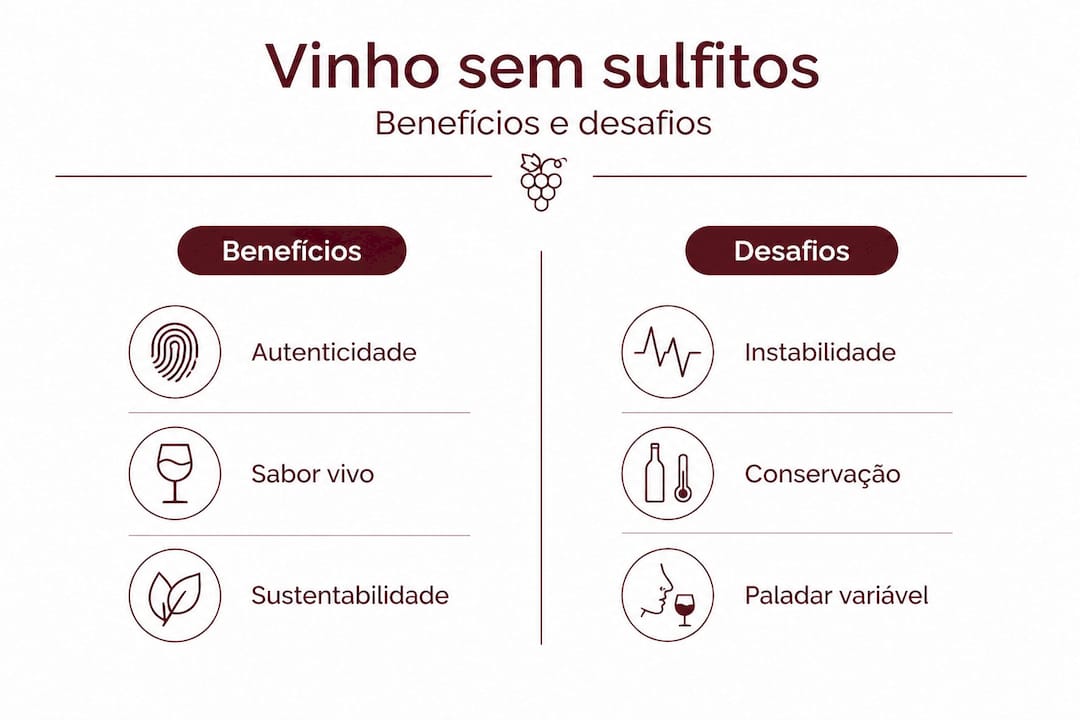
In addition, there are natural wines that demonstrate surprising longevity. For example, excellent natural wines like Covela remain stable for 10 to 12 years under proper storage conditions. This debunks the myth that all sulphite-free wines are fragile and for immediate consumption.
Challenges: instability, preservation and less consensual palates
The other side of the coin is real and should be considered honestly. More unstable sulphite-free wines require rapid consumption, careful storage, and are more vulnerable to oxidation and microbiological contamination. A poorly stored natural wine can turn into an unpleasant experience.
The flavour profile also doesn't appeal to everyone. Some sulphite-free wines present rustic, animal or even slightly acidic notes that can surprise those expecting a conventional and polished wine. They are not worse, they are simply different, and it takes curious and open palates to fully appreciate them.
| Characteristic | Conventional wine | Wine without added sulphites |
|---|---|---|
| Stability | High | Variable |
| Aromas | Controlled and homogeneous | Lively, variable, more expressive |
| Longevity | Long | Depends on the producer |
| Risk of defects | Low | Higher |
| Connection to terroir | Moderate | Intense |
| Home storage | Simple | Requires more care |
Practical tips for choosing and storing sulphite-free wines
- Always buy from trusted producers with a documented history in natural wines.
- Store at a constant temperature between 12°C and 16°C, away from light and vibrations.
- Consume within the period recommended by the producer, usually 1 to 3 years after the harvest.
- Once opened, drink the bottle on the same day or at most the next day.
- Serve at a slightly lower temperature than usual, as it helps to balance the wilder aromas.
Professional Tip: Do not confuse natural wine with faulty wine. The aroma of “brettanomyces” or a slight cider taste can be characteristic of some natural wines, but a truly oxidized or vinegary smelling wine should not be accepted as normal, even in sulphite-free wines.
A curious fact: the amount of sulphites in wine is often lower than that found in dried fruits such as raisins or apricots, which puts into perspective the real impact of this compound on the daily diet.
Finally, the issue of certification is still a hindrance. There is no single legal certification in Portugal that clearly guarantees what a sulphite-free wine is. This can confuse consumers and make informed choices difficult. Understanding the cause of headaches associated with wine helps to demystify much of what circulates in table talk about sulphites.
The natural wine movement and Portugal's role
Considering the advantages and fragilities, the national context offers examples and debates that help to understand this trend with all its richness and complexity.
Portugal holds a unique position in this conversation. With unique grape varieties, ancient soils, and a millennia-old winemaking culture, the country offers exceptional conditions for the natural wine movement to flourish with genuine authenticity. It's not an imported trend, but a return to the origins of those who always knew that the land speaks for itself.
Pioneering regions include:
- Douro: historical producers revisiting ancestral methods with a modern perspective.
- Dão: granite and altitude create naturally fresh wines that require little chemical intervention.
- Vinho Verde: the natural acidity of local grape varieties offers stability without resorting to added sulphites.
- Alentejo: the scorching sun and robust grape varieties like Aragonez and Alicante Bouschet produce rich grapes that ferment with vigour and expressiveness.
Sulphites are essential for the quality and safety of conventional wine, but the natural movement is growing in Portugal due to regional authenticity. Making wine without sulphites is like riding a bicycle without brakes: exciting, but requires skill and balance. Natural wine
Critics of the movement argue that the lack of standardization opens the door to products of irregular quality and consumer confusion. This is a legitimate concern. Without a common language and transparent criteria, the label "natural" can become vague and even be used opportunistically.
But proponents respond with something equally valid: the origin of wine has always been linked to minimal intervention, and recovering this philosophy is to restore to wine its deepest cultural dimension. Portugal, with its rich map of Portuguese wine trends, is well positioned to lead this conversation without losing sight of technical excellence.
An honest look: authenticity versus safety and the future of sulphite-free wines
There's a seductive trap in this debate that needs to be stated clearly: romanticizing the complete absence of sulphites can be as misleading as demonizing them. Not every natural wine is automatically better, healthier, or more authentic. The quality of a sulphite-free wine depends, above all, on the producer's competence, the health of the grapes at harvest, and the production conditions in the winery.
At Xico Sabido, what inspires us most in this movement is not the rejection of sulphites themselves, but the underlying philosophy: the refusal to hide the terroir, the courage to let the wine speak for itself. And that philosophy demands responsibility. It's not enough to remove sulphites and call the wine "natural". It's necessary to respect artisanal winemaking practices, deeply understand the grape varieties and the soil, and have the humility to accept that in some years, nature dictates rules that the winery cannot defy.
The future of sulphite-free wines in Portugal lies in transparency. Producers need to communicate clearly the wine's profile, storage conditions, and flavour expectations. Consumers need to be informed and curious, not just seduced by labels appealing to "natural". And the market needs to create quality benchmarks that help distinguish the genuine from the opportunistic.
Portugal is at the forefront of this trend precisely because its viticultural tradition has never strayed far from the land. The challenge is to transform this pride into an internationally recognized standard of excellence, without losing the soul that makes each bottle unique.
Discover more about authentic wines and the world of natural flavours
If this article has piqued your curiosity about wines that speak directly from the soil where they were born, there's much more to discover. Xico Sabido was born precisely from this passion for Alentejo authenticity, bringing you small productions of wines that tell true stories.

Explore our Alentejo wine route and discover the places where tradition and innovation meet in a glass. Deepen your knowledge of the Alentejo terroir and understand why this region produces some of Portugal's most expressive wines. When you're ready to take the next step, you can buy Portuguese wine directly from our digital cellar, with the convenience of having the best of Alentejo delivered to your home.
Frequently asked questions about sulfite-free wines
Do sulfite-free wines prevent headaches?
Not always, as headaches after wine are often caused by histamines, tyramines or alcohol, and not by sulfites themselves, which only affect a very small minority of people with specific sensitivity.
What does "wine with no added sulfites" mean?
It means that no sulfites were added during production, but the wine may still contain natural traces of up to 10 mg/L resulting from spontaneous yeast fermentation.
Are sulfite-free wines more fragile?
Yes, generally they are more unstable and require greater care in storage, controlled temperature, and faster consumption after opening the bottle to prevent oxidation or contamination.
Is there legal certification for sulfite-free wine in Portugal?
No, in Portugal there is no single legal certification that specifically and uniformly defines or regulates completely sulfite-free wines, which can cause some confusion at the time of purchase.