

Why Choose Additive-Free Wines: An Honest Guide
TL;DR:
- Drinking natural wine isn't automatically healthier, but it requires attention to additives and certifications.
- Choosing additive-free wines reduces exposure to chemicals, enhances terroir, and promotes sustainable practices.
There's a widespread idea these days: that drinking natural wine is automatically healthier. The truth is a little more complex, and that's precisely why it's worth taking the time to understand why choosing additive-free wines with open eyes is important. The market is changing. The interest in additive-free wines is growing among three distinct profiles: Generation Z, connoisseurs of artisanal flavours, and health-focused consumers. But amidst confusing labels, unregulated terms, and exaggerated promises, choosing well requires more than good intentions. This guide aims to clarify all of that.
Table of Contents
- Key Points
- What are Additive-Free Wines?
- Real Benefits of Additive-Free Wines
- How to Identify Additive-Free Wines
- Sustainability and Environmental Impact
- Myths and Realities About Wines with and without Additives
- My Perspective on This Movement
- Explore Xicosabido Wines: Soul of Alentejo
- FAQ
Key Points
| Point | Details |
|---|---|
| Definition not yet universal | There's no global law defining "natural wine"; look for recognised seals for greater confidence. |
| Fewer chemicals, purer taste | Additive-free wines better express terroir and varietal identity, with less oenological intervention. |
| Moderation is always mandatory | Even without additives, alcohol is a toxic substance; drink in moderation to protect your health. |
| Labels require attention | Legislation does not require all additives to be declared on conventional wine labels. |
| Sustainability also benefits | Wineries that produce without additives tend to adopt more environmentally friendly agricultural practices. |
What are Additive-Free Wines?
First of all, it's necessary to separate the wheat from the chaff. "Additive-free wine," "natural wine," "organic wine," and "biodynamic wine" are expressions that often appear together but do not mean the same thing.
An organic wine is produced from grapes grown without synthetic pesticides or fertilizers, but may still undergo some intervention in the cellar. A biodynamic wine goes further, following Rudolf Steiner's philosophy: the vineyard is treated as a living ecosystem, with lunar calendars and natural preparations. A natural wine, in turn, is one produced with minimal intervention both in the field and in the cellar. Hand-picked grapes, spontaneous fermentations, no added industrial yeasts, no fining agents, no stabilizers.
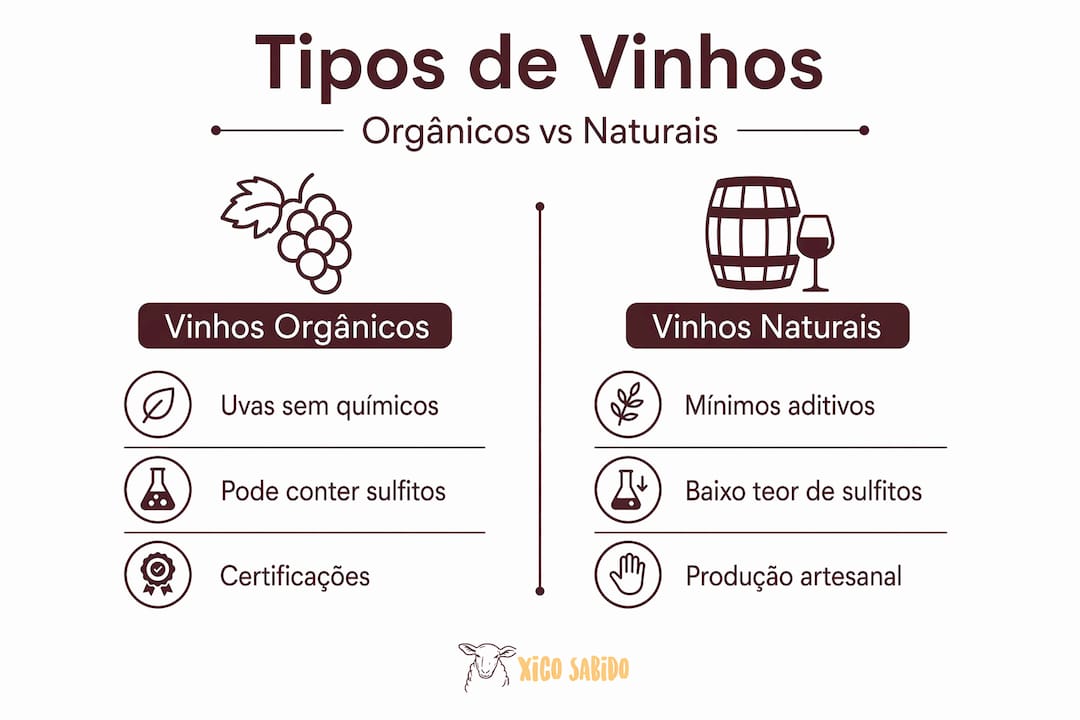
The central problem lies here: the term "natural wine" lacks a universal legal definition, which creates room for much confusion and, at times, commercial opportunism.
As for sulfites, the numbers tell the story. Natural wines limit sulfites to 30 mg/l for reds and 40 mg/l for whites, values much lower than conventional limits, which can reach 160 mg/l for reds and 400 mg/l for whites.
| Wine Type | Sulfite Limit for Reds | Sulfite Limit for Whites |
|---|---|---|
| Natural Wine | 30 mg/l | 40 mg/l |
| Certified Organic Wine | 100 mg/l | 150 mg/l |
| Conventional Wine | 160 mg/l | 400 mg/l |
Pro Tip: Look for the French "Vin Méthode Nature" seal or equivalent certified labels in the Portuguese market. These are currently some of the most reliable guarantees that the wine adheres to strict sulfite limits and truly natural cultivation practices.
Real Benefits of Additive-Free Wines
Here we get to the core of the matter. Why choose organic or additive-free wines? There are concrete reasons, and it's best to present them without excessive romanticism.
Fewer chemicals in your glass
European legislation allows for dozens of oenological additives without mandatory listing on the label. This turns many conventional wines into ultra-processed products without the consumer knowing. By opting for wines without chemical additives, you reduce exposure to substances such as sorbic acid, carboxymethylcellulose, or synthetic fining agents.
Taste that comes from the earth
A wine with few additives tells the story of the place where it was born. The terroir speaks louder when it is not "masked" by oenological corrections. Modern consumers are increasingly rejecting ultra-processed products in favour of a genuine experience, and natural wine precisely responds to this search for authenticity.
Sensitivities and allergies
For those sensitive to sulfites, choosing wines with a lower concentration can make a difference. Headaches, redness, or digestive discomfort associated with conventional wine often have sulfites as the culprit. Reducing their presence can improve the experience, although this is still a field where science calls for more research.
That said, there's a point that cannot be ignored:
- Alcohol is a toxic substance, whether the wine has additives or not.
- Moderation and adequate hydration are the most effective tools to reduce negative impacts on the body.
- Never drink on an empty stomach, regardless of the type of wine.
- A glass enjoyed slowly, with good food and good company, is always a wiser choice than half a bottle in a hurry.
Pro Tip: To better appreciate an additive-free wine, serve it slightly chilled (especially light reds) and let it breathe for a few minutes. Without conventional stabilizers, these wines are more vibrant and evolve quickly in the glass.
To learn more about the relationship between wine and well-being, Xicosabido's article on wine and cardiovascular health explores the topic honestly.
How to Identify Additive-Free Wines
Making a good choice starts with knowing how to read. And the wine market doesn't always make that reading easy.
-
Read the ingredients carefully. In Portugal and the European Union, the obligation to list ingredients on wine labels was recently reinforced, but the practice is not yet universal. Look for labels that declare only "grapes" and, at most, "sulfites."
-
Look for recognized certifications. Seals like Demeter (biodynamic), Ecocert, or Agriculture Biologique (organic) offer verifiable guarantees. The "Vin Méthode Nature" seal from the French Natural Wines Association is one of the most credible references for wines with very low or no sulfites.
-
Investigate the origin of the grapes. Quality starts in the vineyard. Grapes grown without pesticides, in living, biodiverse soils, arrive at the cellar healthier and with less need for chemical correction. Ask the producer. A good producer always answers with pleasure.
-
Be wary of the term "natural" without further information. As the French Natural Wines Association recognizes, the concept is based on the winemaker's ethics, not a strict legal standard. Without a seal or certificate, the word "natural" on the label can mean little.
-
Buy directly from the producer whenever possible. Transparency is much easier to verify when there is a direct relationship between who makes and who drinks. Producers committed to winemaking without additives openly discuss their practices.
Sustainability and Environmental Impact
Why choose additive-free wines goes beyond what happens in the glass. The choice has real consequences for the planet.

The production of natural wines implies harder work in the field and in the cellar, rejecting the monocultures and pesticides that the Green Revolution of the 20th century normalized. In return, it promotes living soils, biodiversity, and resilient vineyards. The results are visible. Sustainable wineries in Alentejo, like Herdade do Esporão, reduced water consumption by 65% and energy by 50%, doubling the soil's organic matter in 15 years.
| Sustainable Practice | Environmental Benefit | Impact on Wine Quality |
|---|---|---|
| Composting waste | Reduces waste and enriches soil | More vibrant soil produces grapes with greater complexity |
| Elimination of pesticides | Protects insects and biodiversity | Healthier grapes, less intervention in the cellar |
| Efficient water management | Reduces pressure on water resources | Vines with moderate water stress gain concentration |
| Biodynamic agriculture | Strengthens the local ecosystem | More faithfully expresses the regional terroir |
Alentejo, with its growing commitment to sustainable viticulture, is now one of Europe's most promising regions in this regard. The scorching heat of the Alentejo summer demands vines that know how to survive with few resources, and this, paradoxically, produces grapes with a soul that cannot be made in a laboratory.
Myths and Realities About Wines with and without Additives
There are two extremes in this debate, and both do little justice to the truth.
On one side, the idea that any wine with sulfites or selected yeasts is an inferior or dangerous product. On the other, the resistance of conventional producers who dismiss the natural movement as a passing fad. Reality lies in the middle.
Responsible producers argue that the moderate and judicious use of sulfites and selected yeasts does not compromise either the quality or the health of the consumer. Modern oenology, when done responsibly and with good practices, produces excellent wines even with some intervention. The problem is not in the intervention itself, but in the lack of transparency and excess.
- Myth: "All conventional wines are harmful to health." False. A good quality conventional wine, consumed in moderation, poses no significant risk to most people.
- Myth: "Natural wine is always better." Not necessarily. Without oenological "crutches," a poorly made natural wine can be unstable, oxidized, or flawed.
- Reality: The quality of the raw material and good production practices are worth more than any isolated label or certificate.
- Reality: The absence of additives is not a guarantee of a perfect wine, but it is a sign of commitment to transparency and to a genuine product.
Conscious choice is not about radicalism. It's about curiosity, information, and pleasure. Just as in cooking, where a good ingredient needs no elaborate sauces, a good grape, well-treated, needs no unnecessary chemicals.
My Perspective on This Movement
I've been following the growth of natural wines for several years, and there's one thing that fascinates me: the way this movement forces the entire industry to ask uncomfortable questions. Questions about transparency, about what's really inside the bottle, about the relationship between who produces and who drinks.
What I've learned is that the greatest value of additive-free wines is not medical or nutritional. It's philosophical. It's the idea that a wine should be honest. That what's in the glass should reflect the vineyard, the soil, the climate, and the hands that made it. Nothing more.
That said, beware of dogmatism. I've tasted truly extraordinary natural wines and natural wines that tasted like poorly disguised vinegar. The seal doesn't replace the work. And I've drunk conventional wines with more soul and more history than many with hastily glued "pure and natural" labels.
What I recommend is simple: ask questions. Look for producers who openly discuss their practices. Prefer an additive-free wine from a producer you know to a beautiful label without a story. And drink slowly, with good company and Alentejo bread on the table. That, more than any certificate, is the secret to a healthy relationship with wine.
— Pedro
Explore Xicosabido Wines: Soul of Alentejo
Alentejo has something unique: a sun that warms the earth like an ancient promise and vines that whisper stories from generation to generation. Xicosabido was born precisely from this land, with the commitment to bring to the glass what is most genuine about the region.

Xicosabido produces wines in small quantities, with carefully selected grapes and practices that respect the soil and the environment. Each bottle is a celebration of Alentejo. If you are looking for wines with character, transparency, and deep roots, explore the selection of Portuguese wine from Alentejo and discover why the Compinchas always come back for more. To accompany a table of healthy flavours, pair with a good high-quality organic olive oil like that from Terra Centuria, another example of a product that respects the land and those who work it.
FAQ
What are additive-free wines?
These are wines produced with minimal or no addition of oenological substances such as sulfites, fining agents, or synthetic stabilizers. The grape and natural fermentation are the sole protagonists.
Are additive-free wines healthier?
They reduce exposure to synthetic chemicals, which can benefit those with sensitivities. However, alcohol is still present, and its effects always depend on moderation in consumption.
How do I know if a wine is truly natural or organic?
Look for recognized certifications such as Demeter, Ecocert, or the French "Vin Méthode Nature" seal. The absence of the term "added sulfites" on the label is also a relevant indicator.
Do natural wines always have fewer sulfites?
Yes, when they follow the limits recommended by the movement: up to 30 mg/l for reds and 40 mg/l for whites, well below the values allowed in conventional wines, which can reach 400 mg/l for whites.
Can I buy additive-free wines directly from the producer in Portugal?
Yes, and it’s the most transparent way to do so. Producers like Xicosabido sell directly to consumers, openly sharing their production practices and commitment to sustainable viticulture in Alentejo.