

How to choose wine accessories and enhance the tasting experience
TL;DR:
- Essential accessories like corkscrews and thermometers enhance the wine tasting experience.
- Decanters and aerators serve different purposes, important for aerating and improving aromas.
- Proper serving temperature and preservation accessories ensure better wine flavour and aromas.
Have you ever felt that the wine you drank on a special night tasted different than at any other time? The difference isn't always in the bottle. Often, it's in what surrounds it. The right accessories transform a simple moment of sharing into a true ritual of pleasure, enhancing aromas, preserving flavours, and making every sip a celebration. In this guide, you'll discover which accessories truly make a difference, how to choose them wisely, and how to avoid spending money on gadgets that end up forgotten in a drawer.
Index
- The essentials: indispensable accessories for any wine lover
- Decanters vs. aerators: when and why to use them
- Perfect temperature: accessories for serving and preserving
- Care and common mistakes when selecting wine accessories
- Our perspective: the real difference accessories make
- Discover more about the world of wine with Xico Sabido
- Frequently asked questions
Key Takeaways
| Point | Details |
|---|---|
| Corkscrews and complements | Having basic accessories like corkscrews, foil cutters, and drip rings allows for hassle-free wine service. |
| Decanter vs aerator | Choose a decanter for special wines and an aerator for everyday practicality. |
| Ideal temperature | Use accessories like a thermometer and ice bucket to always ensure the correct serving temperature. |
| Smart buying | Invest first in versatile accessories before acquiring gadgets for occasional use. |
The essentials: indispensable accessories for any wine lover
Having piqued your curiosity about the impact of accessories, it's crucial to know which ones are truly essential. It's not about filling your kitchen with gadgets, but about gathering those that concretely and tangibly enhance the experience.
The starting point, inevitably, is the corkscrew. There are three main types, each with its purpose. The sommelier's corkscrew, also called a waiter's friend, is a professional favourite: compact, precise, and elegant. With some practice, it allows you to open any bottle with a firm, controlled motion, without wasting a single drop. The electric corkscrew is the ideal choice for those who prioritize practicality above all else, especially in lively gatherings where the focus is on conversation, not technique. Finally, the winged corkscrew is robust and easy to use, perfect for those taking their first steps into the world of wine. Learning how to choose wine often begins by mastering this small detail.
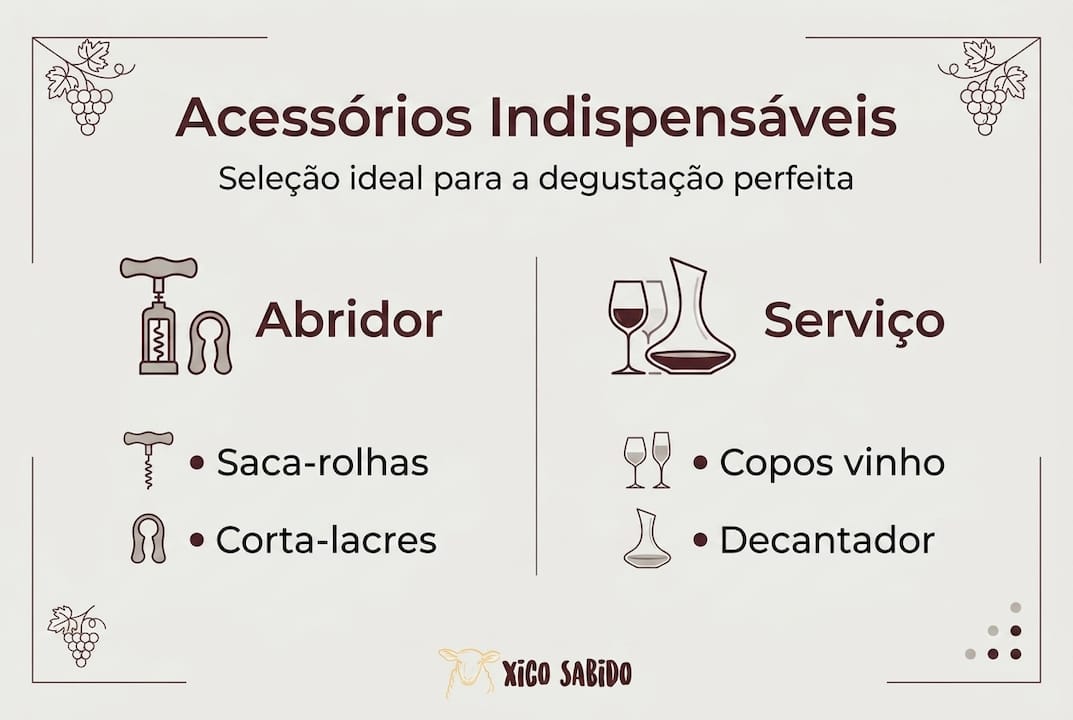
The corkscrew complements are equally important. The foil cutter is often forgotten, but it ensures a clean and safe opening, without tearing the bottle's protective capsule. The wine pourer is another precious ally: it fits into the bottle's neck and allows for serving without spills, controlling the flow naturally. The drip ring sits on the bottle's neck and absorbs the last drops after serving, preventing stains on the tablecloth or table. These small details show care and consideration for those around the table.
According to recommended accessories by wine experts, the sommelier's corkscrew is ideal for those who value precision, while the electric one serves those who prefer practicality. Complements like the foil cutter, wine pourer, and drip ring prevent waste and elevate the service.
For preservation, a vacuum system for open bottles helps preserve the wine's qualities for a few more days. There are simple and affordable vacuum pumps that remove air from the bottle, slowing down oxidation. Familiarizing yourself with wine terms also helps to better understand why preservation is so relevant.
| Accessory | Main function | Recommended for |
|---|---|---|
| Sommelier's corkscrew | Precise and elegant opening | Enthusiasts and professionals |
| Electric corkscrew | Quick and effortless opening | Casual and festive use |
| Foil cutter | Clean capsule removal | All users |
| Wine pourer | Spill-free serving | Daily home use |
| Drip ring | Prevents stains when serving | Dinners and special occasions |
| Vacuum pump | Preservation after opening | Those who enjoy a bottle over several days |
Main advantages of having these accessories:
- Bottle opening without damaging the cork
- Cleaner and more presentable service
- Wine preservation after opening
- Greater control over the tasting experience
Pro Tip: Invest first in a good sommelier's corkscrew. It's the most used, most versatile accessory, and the one that most changes your relationship with each bottle you open. With some practice, it becomes a natural and almost ritualistic gesture.
Decanters vs. aerators: when and why to use them
Having covered the essential accessories, it's important to delve into those that most influence the sensory experience. The decanter and aerator are two of the most discussed accessories among wine lovers, and understanding their differences completely changes how you explore a good Alentejo red.
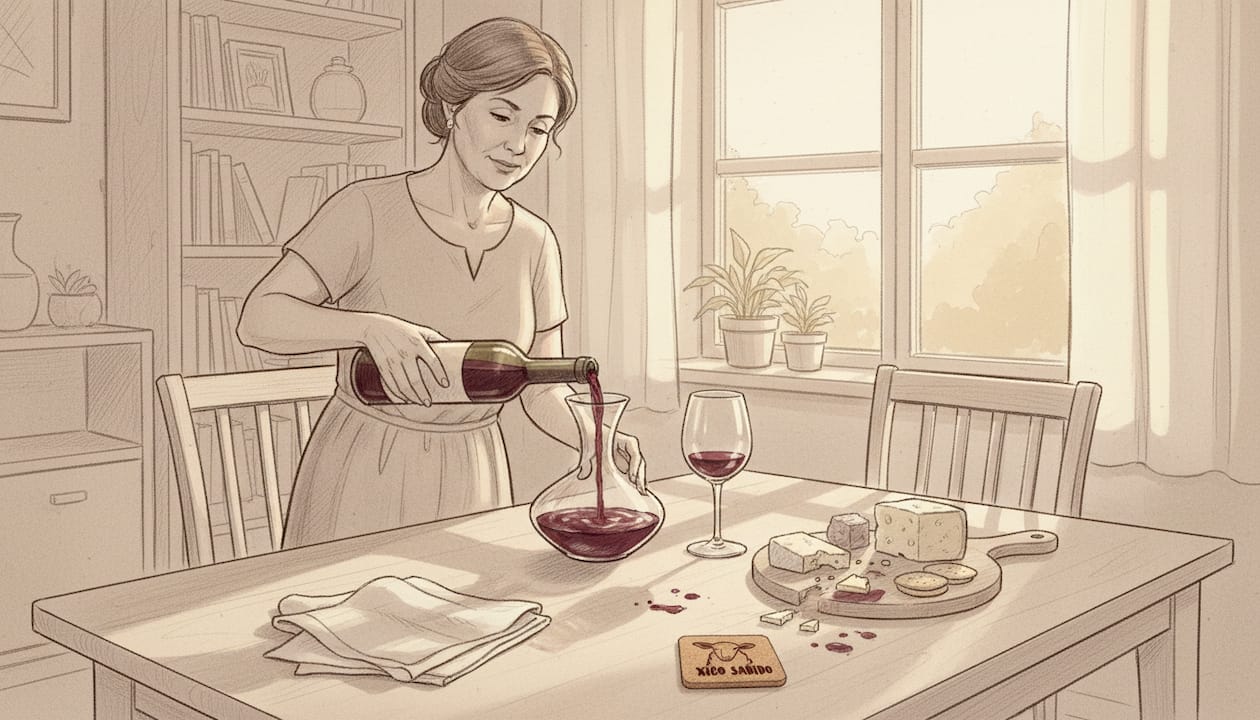
A decanter is a glass vessel, usually with a wide base and narrow neck, into which wine is transferred before serving. Its role is twofold. On the one hand, it gradually oxygenates the wine, opening up its aromas and softening its tannins. On the other, for wines with many years in the bottle, it separates the natural sediment that forms during aging. According to accessory experts, a decanter is used to oxygenate full-bodied young wines for 30 minutes to 2 hours, and to separate sediment in aged wines, in a process of 20 to 60 minutes, improving aromas and softening tannins.
An aerator works completely differently. It's a small device that fits into the bottle's neck or is used when pouring wine into a glass. Instead of patiently waiting, the aerator forces the wine into contact with air in a few seconds, simulating accelerated oxygenation. According to comparative studies, an aerator instantly oxygenates young wines, making it ideal for everyday practicality, while a decanter is indicated for slow oxygenation and sediment separation. It is also important to know that neither should be used with sparkling wines or particularly delicate and fragile wines.
Understanding whether wine is distilled or fermented is a basic but essential step to comprehend why these oxygenation processes only make sense for certain styles.
| Characteristic | Decanter | Aerator |
|---|---|---|
| Oxygenation time | 30 min to 2 hours | Instant |
| Ideal for | Full-bodied reds and wines with sediment | Young wines and daily consumption |
| Aesthetics | Decorative and ritualistic piece | Compact and practical |
| Suitable for sparkling wines | No | No |
| Average cost | Higher | More affordable |
“Decantation is an invitation to patience. It is the gesture of someone who knows that the best things take time.” A maxim that any connoisseur of aged wine recognizes as true.
Pro Tip: For a special dinner with a structured Alentejo red, decant at least 45 minutes beforehand. You'll notice the difference in aromas and texture from the very first sip.
When to opt for one or the other? If you're looking for everyday practicality, the aerator is your ally. If you're preparing for a special occasion, with a wine that deserves to be celebrated calmly, the decanter transforms the service into a moment in itself.
Perfect temperature: accessories for serving and preserving
Having understood the serving accessories, it's time to explore the impact of temperature on enhancing wine. This is probably the most common mistake among home wine enthusiasts: serving reds too warm or whites so cold they lose all their aromatic expression, due to being left on ice.
Temperature is not a minor technical detail. It's the difference between a wine that sings and a wine that whispers quietly without being able to tell what it truly has to say. Essential accessories indicate the ideal serving temperatures: full-bodied reds between 16 and 18°C, light reds between 14 and 16°C, whites and rosés between 10 and 13°C, and sparkling wines or light whites between 6 and 10°C.
| Type of wine | Ideal serving temperature |
|---|---|
| Full-bodied red | 16 to 18°C |
| Light red | 14 to 16°C |
| White and rosé | 10 to 13°C |
| Sparkling and light white | 6 to 10°C |
To achieve and maintain these temperatures, there are specific accessories that make all the difference:
- Wine thermometer: fits into the bottle's neck and indicates the temperature in real time. It's simple, inexpensive, and eliminates any uncertainty.
- Ice bucket: classic and effective for whites, rosés, and sparkling wines. It maintains the temperature throughout the meal.
- Chilling stones: granite cubes or special material that are kept in the freezer and placed in the glass without diluting the wine like ice would. Ideal for those who don't want to alter the flavour.
- Cooling sleeve: wraps around the bottle and maintains the temperature for longer periods, without the need for a bucket.
- Electric wine cooler: for those who take home preservation seriously, it's a worthwhile investment.
Knowing how to drink wine with attention to temperature completely transforms the perception of aromas and the balance between acidity, sweetness, and tannins.
Once the bottle is opened, preservation also requires care. A white wine should be immediately returned to the cold. A red should be stored in a cool place, away from heat sources. Knowing the available oenological products for preservation helps extend the pleasure of each bottle.
Pro Tip: If you don't have a thermometer at home, remove red wine from the fridge 30 minutes before serving. White wines should be placed in the fridge at least 2 hours before. These are simple rules that work in most situations.
Care and common mistakes when selecting wine accessories
After knowing which accessories to choose and how to use them, it remains to understand how to avoid the most common mistakes. There's a natural tendency, especially when we fall in love with something, to want everything. The wine accessories market is full of creative gadgets, some useful, many dispensable.
The first mistake is investing in accessories that don't match your actual consumption profile. If you drink wine sporadically and prefer young, fresh whites, an 80-euro decanter will sit in the cupboard. If you're someone who opens a bottle a week and explores different regions and styles, then the decanter makes perfect sense.
- Not adapting the accessory to the wine style: using an aerator on a delicate wine or a sparkling wine can ruin what was special about it.
- Buying poor quality corkscrews: a cheap corkscrew damages corks and can break the bottle's neck. It's worth investing in a good one from the start.
- Ignoring temperature due to lack of tools: without a thermometer, it's very easy to serve wine outside the ideal temperature.
- Forgetting preservation after opening: leaving the bottle on the counter without sealing it properly accelerates oxidation and wastes the wine.
- Impulse buying during promotions: many accessories look fantastic in the packaging and turn out to be fragile or useless in real use.
“The aerator is an everyday companion. The decanter is the guest for special occasions. Knowing how to combine the two brings the best results for every moment.”
Learning how to open wine correctly, unhurriedly and with the right accessory, is already half the experience. And following tasting tips that teach you to observe the colour, feel the aromas, and perceive the finish makes any accessory more meaningful in context.
The most honest advice is this: start with the basics, use them consistently, and only add new accessories when you feel the experience calls for more. Simplicity has its own elegance.
Pro Tip: Before buying any new accessory, ask yourself how often you will use it. If the answer is "sometimes," think carefully. If it's "every time I open a bottle," that's a good sign it's worth the investment.
Our perspective: the real difference accessories make
There's a truth few openly state: accessories don't replace wine. A sophisticated gadget won't salvage a mediocre bottle, just as a simple glass won't erase the soul of a good Alentejo red. What accessories do, when well-chosen, is create the conditions for the wine to speak for itself.
At Xico Sabido, we believe that the experience should be authentic and personal. Valuing the ritual of opening a bottle, carefully decanting it, serving it at the right temperature, is a way of respecting the work of those who cultivated the vines under the scorching Alentejo sun. But this ritual should adapt to your life, not the other way around.
You don't need a climate-controlled cellar or a collection of decanters to appreciate wine as it deserves. You need curiosity, attention, and the two or three right accessories for your style. Discovering how to combine wine and food with simplicity and pleasure is as revealing as any tool.
The most important thing is always sharing. A good wine, surrounded by the right people, with or without the perfect decanter, is always a celebration.
Discover more about the world of wine with Xico Sabido
To help you go even deeper, we have found tools and content specially selected for you. If this guide has sparked your interest in learning more about wine, you have much to explore in the Xico Sabido universe. From the authentic flavours of our region to the stories each bottle tells, there is always something new to discover.

Explore our wine route through the best wines of Alentejo and let yourself be surprised by the richness of this land. If you want to better organise your collection and keep track of your tastings, discover the best wine management apps for oenophiles. At Xico Sabido, we believe that knowledge is the best accessory of all. Come and be part of this journey with us, my friend.
Frequently asked questions
Why use a decanter instead of an aerator?
A decanter is recommended for slowly oxygenating full-bodied wines or removing sediment from aged wines, while an aerator provides quick oxygenation, making it ideal for young wines and practical for everyday use.
What is the ideal temperature to serve each type of wine?
Recommended temperature ranges are: full-bodied reds at 16 to 18°C, light reds at 14 to 16°C, whites and rosés at 10 to 13°C, and sparkling or light whites at 6 to 10°C.
What accessories should I have for a complete home wine service?
The essentials include a good corkscrew, foil cutter, pourer and drip ring, as suggested by accessory experts, complemented by a thermometer and an ice bucket or cooling stones to control the temperature.
How to avoid spending money on unnecessary accessories?
Prioritise accessories you genuinely use frequently and tailor your choices to your consumption style, remembering that, as experts suggest, an aerator serves daily use and a decanter serves special occasions.