

Controlled origin wine: authenticity and quality in Alentejo
TL;DR:
- The DOC seal guarantees the origin, quality, and respect for the traditions of the producing region.
- The history of controlled origin wine dates back to the 18th century, with the demarcation of the Douro.
- The DOC system in Alentejo includes eight sub-regions, each with distinct profiles and grape varieties.
There's a moment many wine lovers know well: standing before a shelf full of bottles, reading the words "DOC" or "Denominação de Origem Controlada" (Controlled Denomination of Origin) on the label, and not knowing exactly what it means in practice. Is it a quality seal? A guarantee of origin? Or just another acronym producers use to impress? The truth is, controlled origin wine represents much more than an institutional stamp, especially when we talk about Alentejo, a region where the soul of the land can be felt in every sip and where authenticity is not an empty promise, but a tradition cultivated over centuries.
Index
- What controlled origin wine means
- How the concept emerged: the history of controlled origin wine
- DOC Alentejo: characteristics and sub-regions
- How the control and certification of DOC wines works
- What almost no one talks about DOC: authenticity and contemporary challenges
- Deepen your experience: choose, know, and taste true Alentejo DOC
- Frequently asked questions
Key Conclusions
| Point | Details |
|---|---|
| DOC guarantees authenticity | The Controlled Denomination of Origin seal ensures origin, quality, and rigorous production practices. |
| Alentejo has 8 DOC sub-regions | Each Alentejo DOC sub-region presents its own identity, terroir, and grape varieties, all under the supervision of the CVRA. |
| Rigorous control and certification | DOC wines undergo laboratory and taste tests before being approved for commercialisation. |
| DOC is not synonymous with supremacy | Not all great wines need to be DOC, but the seal is responsible for authenticity and regional valorisation. |
What controlled origin wine means
Now that we've introduced the importance of the seal, let's understand what it truly means to have this certification on the label.
Controlled origin wine refers to Denominação de Origem Controlada (DOC), equivalent to Protected Designation of Origin (PDO) in the European Union. It is a quality seal that guarantees the wine was produced in a delimited geographical region, following strict rules on authorised grape varieties, maximum yields per hectare, winemaking methods, and minimum ageing times. It's not just a matter of location; it's a promise that every detail of the process respected the region's values.
Designations of origin are regulated by official entities that verify producers meet all criteria before authorising the use of the seal. This includes:
- Authorised grape varieties: only varieties recognised and approved for the region can be used
- Limited yields: there is a maximum limit of grapes produced per hectare, ensuring quality is not sacrificed for quantity
- Winemaking methods: certain oenological practices are mandatory or prohibited according to regional tradition
- Minimum ageing: some DOCs require specific periods in barrels or bottles before commercialisation
- Sensory analysis: wines undergo tasting tests performed by specialised juries
"A DOC wine isn't simply good. It's a wine that proves, step by step, that it has respected the land where it was born."
The difference between DOC and PDO may seem subtle, but it's important to understand. PDO is the harmonised European designation, while DOC is the traditional Portuguese term that still prevails in consumer communication. In practice, they refer to the same level of certification and legal protection. For those who appreciate wines and want to delve into the fascinating world of controlled origin in wine, this distinction quickly becomes second nature.
Professional Tip: When choosing a wine, always check if the DOC appears followed by the specific region's name, such as "DOC Alentejo" or "DOC Douro." This tells you exactly where it comes from and what rules were applied.
How the concept emerged: the history of controlled origin wine
After understanding what the seal represents today, it makes sense to look at the origins of the Portuguese model and its evolution.
Portugal holds an enviable title in global wine history. The demarcation of the Douro, initiated in 1756 and 1757 by order of the Marquis of Pombal, made it the world's first demarcated wine region. The objective was clear and urgent: to combat falsifications and adulterations that threatened the reputation of Port Wine in international markets. At that time, inferior wines were sold under the name of Port, destroying the confidence of foreign buyers.
The idea was simple in its genius. If there was an officially defined geographical area, with production rules controlled by the State, it would be impossible to pass off a fake wine as genuine. This pioneering logic spanned centuries and inspired equivalent systems in other countries, such as the French Appellation d’Origine Contrôlée.
| Year | Historical milestone | Impact |
|---|---|---|
| 1756 | Demarcation of the Douro by Pombal | World's first demarcated region |
| 1908 | Regulation of Port Wine | Expansion of the model to other regions |
| 1986 | Portugal's accession to the EEC | European harmonisation with PDO |
| 2003 | Unification of DOC Alentejo | Creation of a cohesive regional identity |
| 2009 | European Regulation 479/2008 | PDO as the sole EU designation |
"Portugal did not follow anyone's example. It was Portugal that set the example to the world on how to protect the authenticity of a wine."
This tradition of rigour and protection is part of the pride that every Alentejo producer carries. The origin of demarcated regions is not just academic history; it's the foundation upon which every bottle with the DOC seal is built today.
DOC Alentejo: characteristics and sub-regions
Having understood the historical importance, it's time to focus on the practical application of controlled origin in present-day Alentejo.
The DOC Alentejo was unified in 2003 and comprises eight sub-regions with their own profiles, each with distinct terroir characteristics reflected in the wines produced. Management is the responsibility of the CVRA (Alentejo Regional Wine Commission), which applies rigorous analytical and organoleptic controls to all wines seeking to bear the seal.
The eight sub-regions of the Alentejo wine route are:
- Portalegre: higher altitude, fresh and elegant wines
- Borba: limestone soils, aromatic whites, and full-bodied reds
- Redondo: granites and schists, wines with a mineral personality
- Reguengos: warm climate, powerful and generous reds
- Évora: historic region with balanced and versatile wines
- Vidigueira: strong tradition in fresh and aromatic whites
- Moura: intense heat, concentrated and long-ageing reds
- Granja-Amareleja: the hottest sub-region, unique wines with marked character
| Sub-region | Average altitude | Dominant profile | Featured grape varieties |
|---|---|---|---|
| Portalegre | 400-900m | Fresh and elegant | Aragonez, Trincadeira |
| Borba | 200-400m | Aromatic and full-bodied | Alicante Bouschet, Antão Vaz |
| Reguengos | 150-300m | Powerful and generous | Trincadeira, Moreto |
| Vidigueira | 100-250m | Fresh and aromatic | Antão Vaz, Roupeiro |
| Moura | 150-350m | Concentrated and structured | Alicante Bouschet, Aragonez |
The Alentejo terroir is characterised by long, hot summers, mild winters, and poor soils that force the vines to work to survive. This silent struggle between root and rock is what gives Alentejo wines that intensity of ripe fruit and rich body that so many connoisseurs adore.
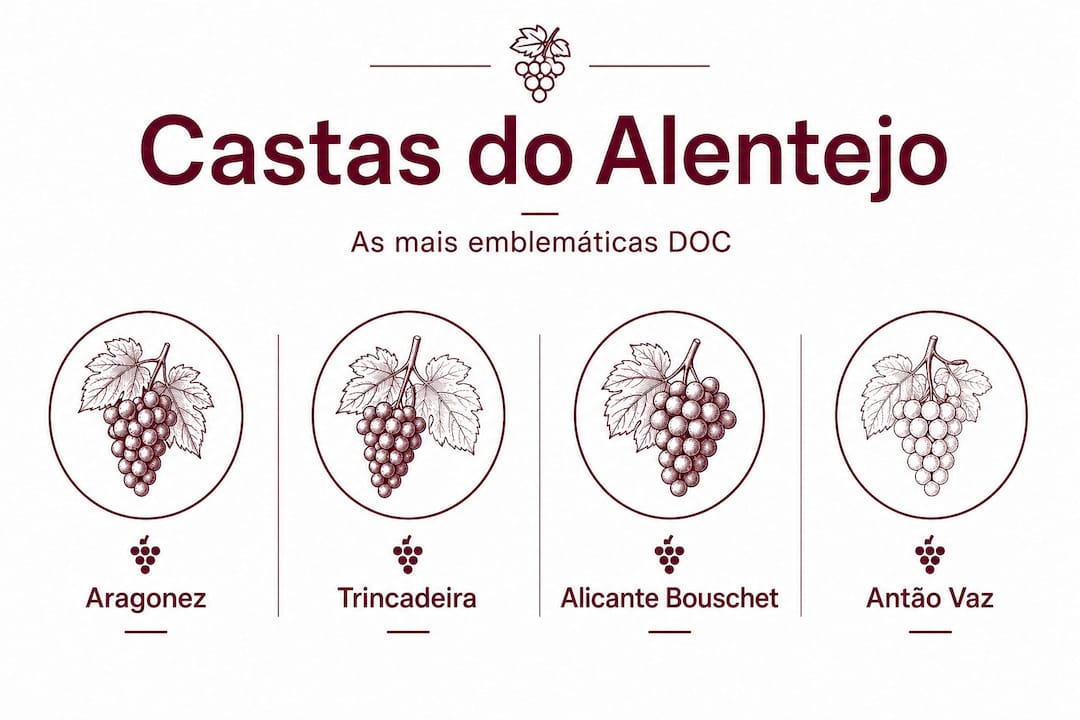
The grape varieties of Alentejo are another inescapable factor of identity. Aragonez, Trincadeira, Alicante Bouschet, and Antão Vaz are names that whisper stories of dry land and scorching sun. In particular, the Alicante Bouschet from Alentejo deserves special mention for its naturally tinted pulp and skin, a rarity in the world of red grape varieties that produces wines of deep colour and unmistakable personality.
Professional Tip: If you want to explore the diversity of DOC Alentejo without spending a fortune, try comparing a red from Portalegre with one from Reguengos. The altitude difference between the two sub-regions creates completely distinct profiles, a masterful lesson in terroir in a single tasting.
How the control and certification of DOC wines works
Knowing where and how DOC wines are produced, it is relevant to understand in detail how integrity and quality are ensured throughout the process.
The IVV supervises PDO and PGI at a national level, while the Regional Wine Commissions (CVR) are responsible for certification at the regional level. In the case of Alentejo, the CVRA is the entity that evaluates each batch of wine before authorising the use of the DOC seal. Bottling can occur outside the region, but only under special control and with specific authorisation from the certifying authorities.
The certification process follows a strict sequence:
- Harvest declaration: the producer reports the quantity and grape varieties harvested to the CVRA
- Laboratory analysis: wine samples are sent to an accredited laboratory, where parameters such as acidity, alcohol content, and the presence of sulphites are measured
- Organoleptic tasting: a jury of tasters evaluates the wine's colour, aroma, and flavour, verifying if it matches the typical profile of the declared sub-region
- Issuance of certificate: if the wine passes both phases, the CVRA issues the certificate, and the producer can use the official back label
- Post-certification control: regular inspections ensure that production practices do not change after certification
"Certification is not a finish line. It's a commitment renewed with every harvest, every batch, every bottle."
This process requires genuine dedication from producers. It's not enough to say you make wine in Alentejo; you have to prove, literally, that you meet all the criteria. And the relationship between price and quality in DOC wines becomes more understandable when you know this rigorous process.
Interestingly, Portugal has developed certified export agreements that internationally recognise DOC/PDO seals, which facilitates entry into foreign markets and values the work of certified producers.
What almost no one talks about DOC: authenticity and contemporary challenges
There is a very common belief among Portuguese consumers that deserves to be questioned honestly: the idea that a DOC wine is automatically superior to any wine without that seal. The reality is more interesting and, at the same time, more demanding for those who appreciate wine with true curiosity.
The DOC system is a powerful tool for protection and regional identity. But it is not an infallible guarantee of absolute excellence. There are wines classified as Vinho Regional, without the DOC certificate, that achieve extraordinary levels of complexity and originality. This happens because producers outside the DOC system have the freedom to experiment with unauthorised grape varieties, less conventional winemaking techniques, and wine profiles that deviate from established standards. This freedom can result in truly unique wines.
On the other hand, the DOC system can also, at times, limit innovation. When the rules precisely define what can and cannot be done, the creative producer feels constrained. Some of the biggest names in Portuguese wine have consciously chosen to produce outside the DOC to have this margin for experimentation. This does not make them less rigorous; it makes them different.
What the consumer should retain is that the real value of DOC lies not just in the wine itself, but in the trust in the system. When you see "DOC Alentejo" on a label, you know that wine has gone through an independent verification process. You know that the grape varieties are correct, that the origin is genuine, that someone other than the producer has validated what is inside the bottle. This transparency has enormous value in a market where falsifications and misleading labels still exist.
To delve deeper into the nuances of controlled origin and understand where DOC shines and where it has limits, the most important thing is to develop one's own palate and genuine curiosity. DOC is an excellent starting point; it doesn't have to be the end point.
Xico Sabido's position is clear: respecting the DOC system means respecting the land, the producers, and the consumers. But respecting wine also means opening your mind to everything that exists beyond official labels, because Alentejo has much more to offer than any certificate can fully capture.
Deepen your experience: choose, know, and taste true Alentejo DOC
For those who want to move from theory to practice, here are suggestions to deepen your contact with the best of Alentejo DOC and expand authentic horizons.
Xico Sabido was born precisely to be that bridge between the land and those who want to truly get to know it. If you're eager to experience in your glass what you've read in these lines, the next step is simple and pleasurable.

You can start by purchasing DOC Alentejo wines directly, with the assurance that each bottle tells a story of verified origin and genuine passion for the Alentejo land. If you prefer to explore in person, our DOC wine route takes you through the ten best places to visit and taste in Alentejo. And for those who want to delve deeper into the soul of this region, the resources on Alentejo DOC tradition show how culture, terroir, and wine are inextricably intertwined. The "Compinchas do Xico Sabido" know well what this means.
Frequently asked questions
Is a DOC wine always better than a wine without a seal?
Not always. DOC guarantees verified rigor and origin, but there are excellent wines produced outside the system that focus on innovation and creative freedom with extraordinary results.
What are the main DOC sub-regions of Alentejo?
DOC Alentejo includes eight sub-regions: Portalegre, Borba, Redondo, Reguengos, Évora, Vidigueira, Moura and Granja-Amareleja, each with its own terroir profile and wine style.
Who is responsible for DOC wine certification in Portugal?
The IVV oversees DOP and IGP denominations nationally, while CVRs certify at the regional level. In Alentejo, this function falls to the CVRA, which applies laboratory analyses and tasting tests.
Can DOC wines only be bottled within the region of origin?
No. Bottling outside the region is permitted, provided it occurs under special control by the competent certifying authorities, guaranteeing the traceability and integrity of the final product.