

Collaborative wines: authenticity, innovation, and rural tradition
TL;DR:
- Collaborative wines preserve producers' identity while promoting innovation and quality.
- The model fosters environmental sustainability, technological efficiency, and territorial value.
- Cohesion and governance are challenges, but transparency ensures the collective's success.
Collaborative wines: authenticity, innovation, and rural tradition
There's a misconception that persists in the Portuguese wine universe: confusing collaborative wines with the old cooperative model, where identity dissolved into the masses and quality often took a back seat. But the paradigm is changing with surprising speed. Digital innovation, combined with a new generation of producers passionate about the land, is creating collectives that unite the best of rural tradition with 21st-century tools. In this article, we explore what collaborative wines truly are, how they differ from historical cooperatives, what advantages they bring to producers and consumers, and how technological projects are redefining the future of the sector in Portugal.
Index
- What are collaborative wines and how do they differ from traditional cooperatives
- Advantages for producers and consumers: quality, authenticity, and sustainability
- The role of digital innovation: ViSUS, VITISENSE projects and the future of collectives
- Challenges and nuances: maintaining unity, fair prices, and identity in collaborative contexts
- Why the future is collaborative: the vision for the coming years
- Explore, taste and experience collaborative wines with Xico Sabido
- Frequently asked questions
Key Takeaways
| Point | Details |
|---|---|
| Identity and authenticity | Collaborative wines strengthen the connection to origin and highlight each producer's story. |
| Innovative sustainability | The adoption of technological platforms makes production more efficient and ecological. |
| Fair value for producers | Collaborative models allow for better remuneration and access to more demanding markets. |
| Challenges require unity | Success depends on cohesion and shared values among collective members. |
What are collaborative wines and how do they differ from traditional cooperatives
To understand the true essence of collaborative wines, it's important to clarify how they differ from traditional cooperatives. The word "collaborative" can be misleading at first glance: it seems synonymous with cooperative, with mass sharing, with faceless wines. Nothing could be further from the truth.
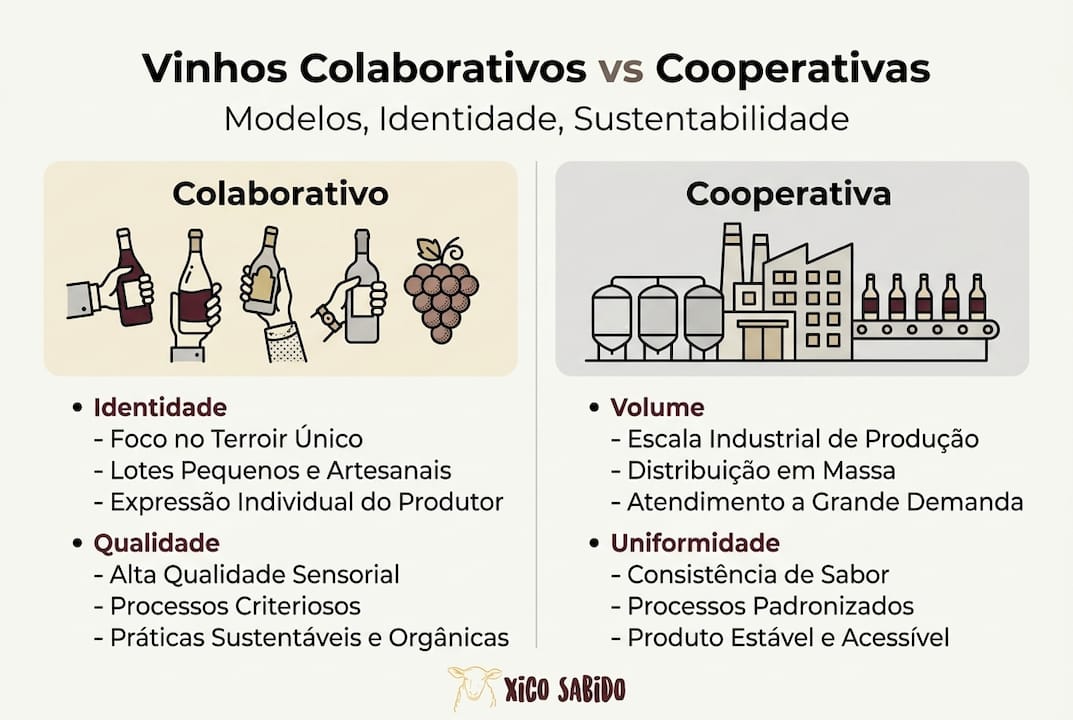
A collaborative wine arises from the intentional sharing of resources, knowledge, and innovation among producers who maintain their individual identity. Instead of diluting the origin, the collaborative model amplifies it. Each producer contributes their best, whether it's the grape variety, the soil, the altitude, or ancestral knowledge, and the collective transforms this sum into a value proposition that no single producer could create alone.
Traditional cooperatives, for decades, operated differently. The producer delivered their grapes, received payment based on weight and acidity, and the resulting wine often lost its connection to its region of origin. Models such as those of the Lavradores specifically avoid this anonymity, focusing on premium quality and preserving the identity of each involved quinta (farm), unlike traditional cooperative projects where grape prices and labor conditions were often criticized.
"Wine tells the story of the land where it was born. When that story is lost in mass production, the wine loses its soul."
Modern hybrid models like Lavradores de Feitoria, in the Douro, or initiatives for a journey of flavor and tradition such as those promoted by Xico Sabido in the Alentejo, show that it is possible to join forces without sacrificing the soul of each wine.
See the practical differences between the two models:
| Dimension | Traditional cooperative | Collaborative wine |
|---|---|---|
| Identity | Predominant anonymity | Preserved identity |
| Governance | Centralized, bureaucratic | Shared, agile |
| Quality | Variable, volume-oriented | Premium, origin-oriented |
| Marketing | Generic, little differentiated | Strong and territorialized narrative |
| Value to producer | Often low | Fair and quality-based |
Some differences that make collaborative wines unique:
- Participatory governance: each producer has a say in collective decisions
- Rigorous grape selection: quality is an entry criterion, not just volume
- Origin narrative: each wine maintains a clear connection to its territory
- Equitable value distribution: the producer receives more when the wine is worth more
- Shared innovation: tools and knowledge circulate among all members
This model demands more commitment and communication, but the results speak for themselves. Consumers gain access to wines with genuine character. Producers gain recognition and fair income. And the region gains visibility.
Advantages for producers and consumers: quality, authenticity, and sustainability
Having understood the basic concept, it's important to grasp what makes this model so advantageous for all involved. The numbers don't lie, and the real success stories in Portugal are increasingly expressive.
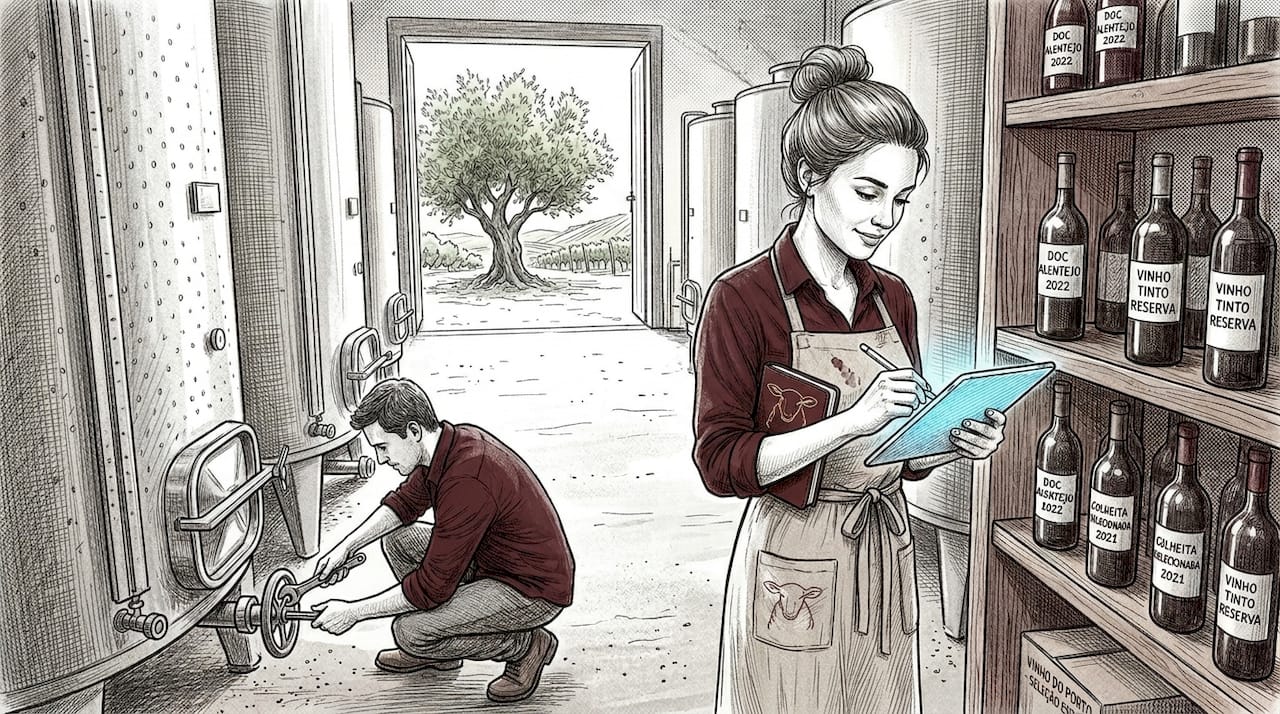
Lavradores de Feitoria is perhaps the most cited example: 47 shareholders, 20 quintas and over 600 hectares of vineyard in the Douro, with documented gains in cooperatives via clonal selection reaching 10 to 40% improvement in agricultural yield and 15% in grape quality. These are not theoretical numbers. They are the result of decades of shared work and a consistent commitment to excellence.
For producers, the advantages are concrete and measurable:
- Increased income: the sharing of advanced techniques and clonal selection increases quality production per hectare
- Access to premium markets: together, producers can enter markets that would be inaccessible individually
- Shared innovation costs: digital tools, analysis laboratories, and oenological consulting become more accessible
- Stronger negotiation: the collective voice carries more weight in negotiations with distributors and retailers
- Environmental sustainability: sharing best practices reduces pesticide use and optimizes water management
For consumers, the collaborative model offers something that goes beyond taste:
- Traceable authenticity: each bottle tells a verifiable story, from producer to glass
- Consistent quality: shared standards ensure uniformity without sacrificing individual character
- Emotional connection: buying a collaborative wine is supporting a real community, with faces and stories
- Rich diversity: several producers under the same collective result in a more varied and interesting flavor palette
- Fair price: collective efficiency allows for competitive prices without compromising quality
If you are learning how to choose Portuguese wines, looking for wines with a declared collaborative origin is an increasingly relevant criterion. Authenticity is not an abstract concept: it's in the land, in the hands that work the vineyards, and in the honesty with which the wine reaches you.
As for sustainability, the impact is equally significant. Resource sharing reduces the individual environmental footprint of each producer, and collective intelligence accelerates the adoption of more ecosystem-friendly practices. This entire journey, from soil to bottle, can be followed in Xico Sabido's vision of the process from field to bottle.
Professional Tip: When choosing a collaborative wine, look for information on the back label about the number of producers involved and the specific location of the vineyards. This transparency is the clearest sign that you are dealing with a project genuinely committed to authenticity.
The role of digital innovation: ViSUS, VITISENSE projects and the future of collectives
At the root of many of these gains is the digital revolution and new tools shared among producers. And in Portugal, there are concrete examples that prove that tradition and technology not only coexist but mutually reinforce each other.
The ViSUS project, developed within the Vinho Verde region, is a sustainability indicator management platform that allows producers in a collective to monitor KPIs in real-time and optimize the use of resources such as water, energy, and fertilizers. Instead of each producer acting in isolation, the system creates a shared vision of the environmental performance of the entire collective. The result is a concrete reduction in inputs and greater consistency in agricultural practices.
The VITISENSE project goes even further: it uses artificial intelligence to monitor grapevine nutrition in real-time, integrating data from sensors installed in the vineyards with predictive models that alert producers to imbalances before they become serious problems. In cooperatives and collectives that have adopted this system, the reduction of losses due to water stress or nutritional deficiencies has been significant.
The advantages of digital innovation in wine collectives are numerous:
- Data-driven decisions: instinct gives way to objective and shared information
- Complete traceability: consumers can know where each batch of grapes comes from
- Measurable sustainability: environmental gains are quantified and communicated with credibility
- Operational efficiency: less waste, better management of time and resources
- Transparency for the market: international buyers increasingly demand data on sustainable practices
Important statistic: The adoption of collective digital tools by Portuguese producers has grown significantly, with Vinho Verde collectives leading the environmental and digital transition of the sector, creating a replicable model for other regions.
Xico Sabido closely follows this movement, convinced that technology in wine is not a threat to tradition but its best ally. And when it comes to more natural practices and the reduction of chemical intervention, it is also worth exploring the world of natural alternatives in wine that are gaining strength in the most innovative collectives.
Professional Tip: When evaluating a wine collective, ask if they use digital monitoring platforms. A collective that measures and shares sustainability data is almost always a collective with greater rigor, more transparency, and better wines.
Challenges and nuances: maintaining unity, fair prices, and identity in collaborative contexts
Despite the advantages, collaborative wines are not without obstacles and require intelligent solutions. Collaboration, however promising, faces human and economic realities that do not disappear by decree.
The biggest challenge is, perhaps, the most human of all: maintaining cohesion. When the collective goes through a difficult year, whether due to drought, falling prices, or internal governance disputes, the temptation for each producer to act individually is strong. Trust, built slowly, can quickly deteriorate.
"The strength of a collective is measured not in good years, but in how it faces crises together."
Pressures on grape prices are another sensitive point. Traditional cooperatives have often been criticized for paying little for their members' grapes and for precarious working conditions. But models like Lavradores de Feitoria show that evolution is possible: when quality defines the price and not just volume, the producer is valued for what they truly contribute.
The most common challenges in wine collectives include:
- Governance conflicts: collective decisions are slower and require consensus, which can hinder innovation
- Imbalance of contributions: not all producers have the same technical or financial capacity
- Price pressure: the global market demands competitiveness, which can compress the margins of smaller producers
- Dilution of identity: the larger the collective, the greater the risk of wines losing their individual character
- Technological dependence: adopting digital tools requires training and investment that not everyone can afford
The solution involves a combination of constant communication, clear governance rules, and genuine commitment to the collective's founding values. The success stories in Portugal show that when these elements are present, challenges become catalysts for growth rather than reasons for dissolution.
For producers who want to deepen the quality of their wines within a collective, exploring oenological improvements is an essential step. Innovation starts in the vineyard but is consolidated with rigor and shared technical knowledge.
Why the future is collaborative: the vision for the coming years
Let's now look at the innovative essence and what is truly at stake for the future of Portuguese wines. Some are skeptical of the collaborative model, arguing that collaboration compromises individuality and that the market always rewards the singular project with a unique name and face. This argument has some merit, but it ignores a deeper truth.
Authenticity, in the 21st century, is no longer the exclusive domain of the solitary producer. It can emerge from the collective when there is a genuine common purpose, transparent rules, and the courage to preserve the identity of each member. The link between rural tradition and digitalization is not a contradiction: it is the most real competitive advantage that Portuguese wines have in an increasingly demanding global market.
Critics have not yet realised that modern consumers do not want to choose between authenticity and innovation. They want both. And the best Portuguese wine collectives are offering exactly that. The farm-to-glass experience is richer when lived in a community, shared with pride, and supported by values that stand the test of time.
The future belongs to collectives that know how to honour their roots while embracing the tools of the present. In Alentejo, in Douro, in Vinho Verde, this story is being written now.
Explore, taste, and experience collaborative wines with Xico Sabido
To put your knowledge into practice and savour authentic collaborative wines, explore the following suggestions. The world of collaborative wines makes even more sense when experienced up close, amidst landscapes that whisper stories and people who have much to share.

Xico Sabido invites you to discover viral Portuguese wines that are conquering new audiences with authenticity and personality. Explore an Alentejo wine route to discover the places where tradition and innovation meet in a glass, and deepen your knowledge of the Alentejo grape varieties that give soul to each bottle. Because tasting wine is always a way of belonging to something greater.
Frequently asked questions
What distinguishes a collaborative wine from a cooperative wine?
Collaborative wines preserve identity and focus on the premium quality of each producer, while traditional cooperatives tend towards anonymity and a lesser individual appreciation of the producer. In a collaborative collective, the name and origin of each estate carry weight in the final proposal.
Are collaborative wines more sustainable?
Yes, the use of shared digital platforms such as ViSUS and VITISENSE allows for greater efficiency in resource use, environmental traceability, and a significant reduction in waste. Sustainability is easier to achieve together.
What benefits do producers participating in collaborative projects have?
They gain proven agricultural income, with improvements of 10 to 40% in production and 15% in grape quality, and access to technological innovation that would be inaccessible individually. The collective is also a network of technical and commercial support.
Are there risks in collaborative wines?
Yes, maintaining internal cohesion, negotiating fair prices for all members, and managing governance conflicts are frequent challenges that require constant communication and clear rules. When well managed, these challenges strengthen the collective instead of fragmenting it.